
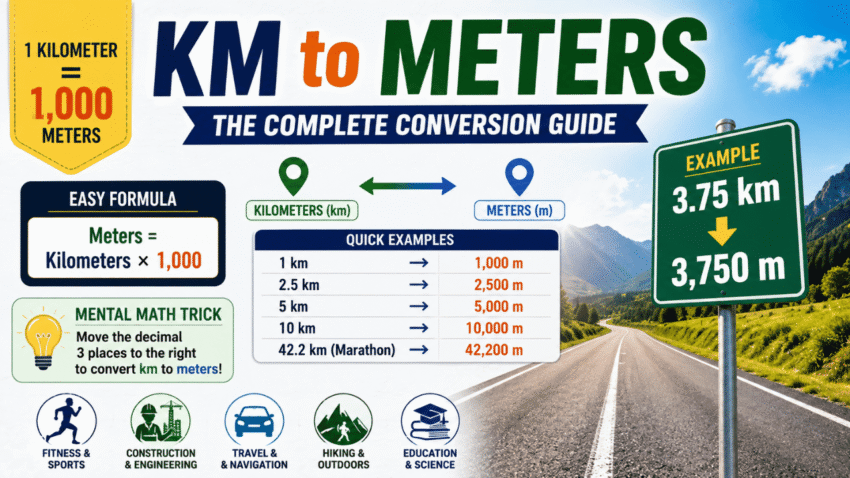
Whether you are doing a school project, going on a road trip, determining how far you need to run each day or working in an engineering lab, converting kilometers to meters is one of the simplest forms of measurement conversion that you can do as part of your work with the metric system. Regardless of how simple the underlying math actually is, a lot of people will still take a break and double-check themselves every time they have to convert KM to Meters. This guide covers everything you need to know, from the formula to examples in practice, so that you never have to second-guess a KM to Meters conversion ever again.
KM to Meters Converter
Kilometers to Meters Calculator
Understanding the Basics
Understanding the Basics of KM and Meters. Before we proceed to converting KM to Meters, it is important for us to understand what these two units are in the metric system. A kilometer is a metric unit of length equal to 1,000 meters, and its prefix kilo itself just means thousand in the metric system- the same prefix used for kilogram (1,000 grams) or kilowatt (1,000 watts).
KM to Meters conversions are so easy, in fact, that the way you proceed with metric system units, and thus KM to Meters conversion, is sort of a constant pattern which results in this whole process being relatively easier than the requirement for strict adherence to less instinctual systems based on inconsistent conversion factors.
The KM to Meters Formula
It has never been too easy to convert KM into Meters (or vice versa), and simply as below:
Meters = Kilometers × 1,000
That's the entire calculation. Since one kilometer is exactly equal to 1,000 meters always, converting from kilometers to meters simply requires you to multiply the kilometer figure by 1,000. No rounding, no approximation, and no complex formula required - which is precisely the reason lazy KM to Meters conversions are sometimes the first examples ever taught in metric schools.
Basic KM to Meters Conversion Formula
| Conversion Direction | Formula |
| Kilometers to Meters | Multiply by 1,000 |
| Meters to Kilometers | Divide by 1,000 |
Common KM to Meters Conversions
With so many day-to-day events needing a rapid km to m answer, it is useful to have a reference table immediately available for some of the most frequent values.
| Kilometers | Meters |
| 0.5 km | 500 m |
| 1 km | 1,000 m |
| 2 km | 2,000 m |
| 5 km | 5,000 m |
| 10 km | 10,000 m |
| 21.1 km (Half Marathon) | 21,100 m |
| 42.2 km (Marathon) | 42,200 m |
| 100 km | 100,000 m |
It really speeds things up having this kind of table at your fingertips, rather than firing the KM to Meters calculation every time you start a workout - especially useful when it comes to commonly used markers such as running race distances.
How the Metric System Makes This Simple
Thus, the most significant benefit of any KM to Meters conversion is entirely in how reliably the metric system scales. This is all because the metric system is built around powers of ten (a base ten system), so between km/meters/cm/mm, it has a standard and very simple multiplication or division each time you switch units.
This is in contrast to imperial units (miles, yards, feet, and inches), where it takes a lot of memorization (and more inconsistency) to simply convert between miles, yards, feet, and inches by remembering multiple conversion factors. There is absolutely no quality associated with the conversion, as a KM to Meters conversion will involve only multiplying by 1,000, which eliminates any illusion of guesswork behind it, whatever the distance you are working with.
Metric Length Units at a Glance
| Unit | Equivalent in Meters |
| Kilometer (km) | 1,000 meters |
| Meter (m) | 1 meter |
| Decimeter (dm) | 0.1 meters |
| Centimeter (cm) | 0.01 meters |
| Millimeter (mm) | 0.001 meters |
Visualizing the complete picture in this way allows for any one KM to Meters conversion to be placed into a larger view so that kilometers and meters can really be seen side by side with other metric length units.
Real-World Situations Where You'll Need This Conversion
Learn how to convert KM to Meters isn't only a theoretical problem, this appears in daily circumstances.
Running and fitness tracking. However, although many running apps or race organizers might list distances in kilometers, some training plans or track workouts are measured in meters, especially for shorter interval training sessions. Converting between kilometers and metric with common running measures is very helpful, especially if you balance both formats - being able to easily convert from KM to Meters without confusion.
Construction and engineering projects. Blueprints, land surveys, construction plans commonly mix kilometer scale for long distances and meter level precision for localized work making KM to Meters a common conversion performed by many engineers and technicians alike.
Travel and navigation. Most road signs and GPS systems in the world measure distances in kilometers, but some contexts like hiking trail markers and the location on a map show the distance to be measured using meters, so you have this constant alternating situation where you need to perform KM to Meters conversion.
Academic and scientific work. In physics, geography, and general science courses, distance, speed, time problems often require students to convert between kilometers and meters as well (or even other units).
KM to Meters in Everyday Contexts
| Scenario | Typical Unit Used | Conversion Needed |
| Marathon Distance | Kilometers | Convert to meters for pace calculations |
| Track and Field Sprints | Meters | Rarely needs KM to Meters conversion |
| Road Trip Distances | Kilometers | Occasionally converted for precise local navigation |
| Land Surveying | Both | Frequently requires KM to Meters conversion |
| Hiking Trail Markers | Meters (often) | May require converting trailhead distances from km |
Step-by-Step Example Calculations
For further clarity on the KM to Meters process, lets see a few worked examples of how this conversion looks with various starting values.
Example 1: Convert 3.5 kilometers to meters. 3.5 × 1,000 = 3,500 meters
Example 2: Convert 0.25 kilometers to meters. 0.25 × 1,000 = 250 meters
Example 3: Convert 15.75 kilometers to meters. 15.75 × 1,000 = 15,750 meters
As these examples demonstrate, every KM to Meters conversion uses the same basic process no matter how complex your starting figure is. To finish the conversion, just shift the decimal point to the right three positions.
A Quick Mental Math Trick
For a quicker approach to converting KM to Meters without reaching for the calculator, use this neat trick: move the decimal place three spaces to the right, and there is your answer - since 1,000 times by shifting the decimal point is exactly mathematically equivalent. For instance, 4.2 kilometers becomes 4,200 meters by just shifting the decimal three places over. This shortcut works 100% of the time and is actually one of the quickest ways to solve a KM to M conversion in your head without pen and paper or any tools.
Converting Meters Back to Kilometers
We should spend some time discussing the reverse process, because learning both directions provides a simple understanding of how KM and Meters relate. We can easily go back into kilometers from meters by dividing the meter figure (in this case 18) by 1,000, which is literally the opposite operation of a conventional KM to Meters conversion. 7,500 meters = 7.5 kilometers. This means you can easily move from one conversion to the other, either way, once you understand the relationship between units because they are based on a common number factor of 1,000.
Also Read: How Long Is 2 Meters | How Far Is 500 Meters | How Long Is 5 Meters
Conclusion
Aside from the more challenging unit conversion, converting KM to Meters is one of the easier unit conversions considering the base-ten, metric style uniformity. Whether it is finding running splits, going through a construction project, or just completing a math assignment, remembering that one kilometer always equals exactly 1,000 meters and that the entire conversion from kilometers to meters is just multiplying and moving around decimal points makes doing any KM to Meters calculation fast, accurate, and really, really easy!
Frequently Asked Questions
1. How do you convert KM to M?
For every 1 kilometer, you will multiply by 1,000. 1 km = 1000m, therefore 5km = 5000 m and so forth.
2. How many metres in one kilometre?
1 kilometer = exactly 1000 meters
3. What is the formula to convert KM to Meters?
Meters = Kilometers × 1,000.
4. Is there a shortcut to converting KM to meters?
Yes. Shift the decimal three digits to the right.
5. Why is it so easy to convert km to meters?
The metric system is based on powers of ten, which makes conversions simple and uniform.