

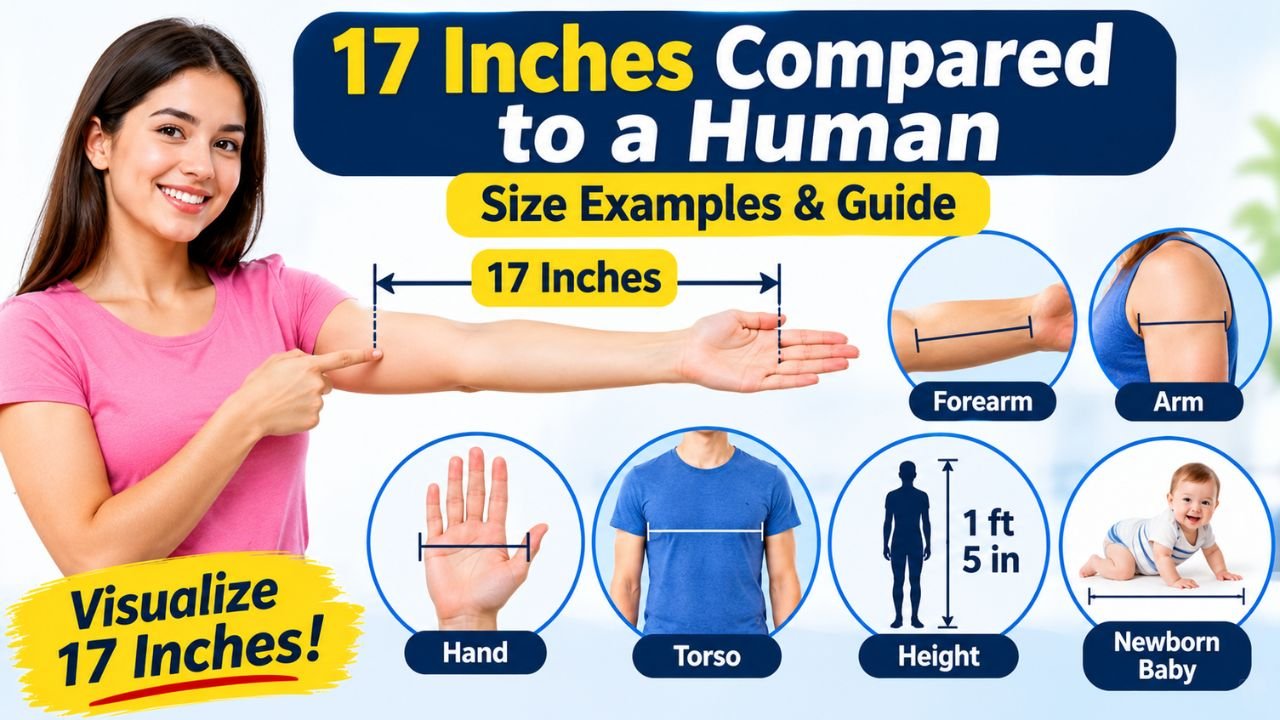
It may be difficult to understand what a number represents when all you have is the number. While 17 inches doesn’t seem like a very large distance, comparing that distance to your own body parts will give you a better idea of how long it really is. This technique will help you visually represent measurements, whether they are for objects, products, or simply for curiosity about the proportions of humans.
At 17 inches (approx. 43.18 cm/1 ft. 5 in.) relative to a human being, this measurement is equivalent to the approximate length of an adult’s forearm; however, individual body proportion differences exist. Additionally, while it is considerably longer than an average adult’s hand, it is considerably shorter than the total height of an individual.
The guide describes 17 inches compared to a human using various body parts (forearm, arm, hand, torso, and total height). The guide also compares 17 inches to newborn infants and young children, and provides easy conversion techniques so you can relate the size of 17 inches to your own body.
How Big Is 17 Inches Compared to a Human?
Seventeen inches may be considered a moderate length in terms of individual human body parts; however, it is a relatively small portion of an adult’s overall height. To illustrate this point, if we look at an adult who stands 5 feet 8 inches tall (68 inches), then the 17 inch measurement would equal exactly one-quarter of their overall height.
The simplest way to visualize this measurement is by picturing a standard 12-inch ruler that has been extended by an additional 5 inches in total length. This will give you a total of 17 inches of straight measurement.
| Measurement Unit | Equivalent |
| Inches | 17 inches |
| Feet and inches | 1 ft 5 in |
| Decimal feet | 1.4167 ft |
| Centimeters | 43.18 cm |
| Millimeters | 431.8 mm |
| Meters | 0.4318 m |
| Yards | 0.4722 yd |
These conversions will help you understand what 17 inches means in relation to a human being, especially if you use the metric system. This measurement is longer than a 12 inch ruler by about an inch and is equal to more than 43 centimeters.
17 Inches Compared to the Human Forearm
The forearm is a great place to visualize what 17 inches looks like. The forearm is the portion of your arm that extends from your elbow to your wrist. However, forearms vary in size due to factors such as height, age, and body proportion.
For some adults, the upper arm can be almost 17 inches long, and for others, it will be much shorter. Therefore, 17 inches is a relative measure of adult upper arms, and not a typical upper arm length.
Measure from the end of your elbow to the fold at your wrist, with a tape measure. Be sure to keep your arm in a relaxed position while measuring on the same line. A measurement that is near 17 inches will serve as an effective self-reference.
The forearm is merely one part of your arm. Your upper arm is located between your shoulder and your elbow.
17 Inches Compared to a Human Arm
A complete human arm extends from the shoulder to the fingertips. Therefore, because it includes both the upper arm and forearm, 17 inches is generally only a fraction of an adult’s entire arm length.
The difference is dependent upon the person’s height and body structure. If you have short arms, then 17 inches will take up a greater portion of your arm than if you were taller.
| Body Measurement | How 17 Inches Compares |
| Upper arm | May cover a portion of the upper arm |
| Forearm | Can approach the forearm length of some adults |
| Full arm | Usually represents only part of the arm |
| Shoulder to fingertips | Shorter than the complete measurement for most adults |
Is 17 Inches Half of a Human Arm?
Arm length is variable. Therefore, 17 inches can be less than half of an individual’s arm and a different percentage of another. Additionally, the size of both the upper arm and lower arm differs.
To get a good idea of how well you fit, take a measurement from the tip of your shoulder down to the very end of your fingers. Compare this number with 17 inches. You will find that taking the time to do this is much more reliable than making the assumption that all individuals have exactly the same body shape.
Also Read: How Big Is 5 Inches | How Big Is 7mm | How Big Is 10 Inches
17 Inches Compared to a Human Hand
The adult hand has an average length of about seventeen inches. The length of a hand is usually measured from the crease of the wrist to the tip of the middle finger. In contrast, the width of a hand is referred to as the measurement taken across the palm.
As people have different sized hands, there is no one size for measuring hands that applies to all individuals. However, if you think of 17 inches as being the length of several hands lined up next to each other, this may give you an idea of how much larger 17 inches is compared to just one hand.
This is a great day-to-day comparison to make when you don’t have a tape measure with you. It is only an approximation since people’s hands are different sizes.
17 Inches Compared to the Human Torso
The body from the waist up is composed of three sections: the chest, the abdomen, and the back. An assessment of 17 inches can be made at any point within the torso; however, the significance of that measurement will depend upon what location was measured and how it was measured.
As an example, 17 inches can be used to measure the height of a person’s upper body (the top portion of their trunk) or can be used as a linear measurement from one side of their chest to the other. However, this is not a measurement of the total length of the upper body for the majority of adults.
It’s crucial to differentiate between length and circumferences. A straight 17 inch segment of your body will be different than wrapping a measuring tape around your chest or waist.
The distinction is particularly helpful in identifying clothing size or in comparing body dimensions. In all cases, identify the type of measurement used prior to utilizing that measurement as a reference.
17 Inches Compared to Human Height
The average height of adults is many times greater than 17 inches. Therefore, 17 inches would be considered short when compared to the average height of adults.
The person being considered has a total height of 68 inches (5 feet, 8 inches). To find out what portion of the total height is represented by 17 inches, calculate the percentage by dividing 17 by 68 and then multiplying the resulting number by 100.
17 ÷ 68 × 100 = 25%
Thus, 17 inches is a representation of one quarter (1/4) of a person that stands at 5 feet and 8 inches.
| Adult Height | Total Height in Inches | 17 Inches as a Percentage |
| 5 ft 4 in | 64 in | 26.6% |
| 5 ft 6 in | 66 in | 25.8% |
| 5 ft 8 in | 68 in | 25.0% |
| 5 ft 10 in | 70 in | 24.3% |
| 6 ft 0 in | 72 in | 23.6% |
These numbers represent a mathematical comparison of a person’s height, as opposed to measuring a specific area of the body. As an individual’s height grows, the 17-inch portion of that height becomes a smaller percentage of his/her total height.
17 Inches Compared to a Newborn Baby

This is the size of a new born baby. New borns have a length of about 17 inches at birth. However, there are many variations in these measurements.
It is important to keep in mind when comparing 17 inches to a baby at this point in their life, that all babies grow at different rates and some may be shorter than average and some may be taller. Also, a baby’s body will change rapidly during its first year of life.
A 17-inch length may be used to illustrate how small a newborn baby could potentially be. Nevertheless, this does not represent the newborn baby’s total width nor does it represent the baby’s complete physical dimensions.
When shopping for items such as baby clothing, blankets and more, use the size chart provided by the manufacturer rather than simply using a generic length estimate.
17 Inches Compared to a Child
For children, 17 inches can be a significant portion of their bodies depending on how tall they are, what age they are and other developmental factors.
It may be used to measure part of a child’s torso or limb, however it is not appropriate to use it to determine the child’s entire height or to evaluate how much the child has grown. Since each child develops on his/her own timeline, the proportions of their bodies change throughout their development process.
For accurate results when measuring for clothes, furniture, or equipment, it is best to take measurements of the person/child or area that needs to be measured rather than making a general comparison.
How Does 17 Inches Look on a Measuring Tape?
Using a measuring tape can help you see what that distance looks like. You will want to begin by placing the tape at zero and extending it out until you reach the 17-inch point. If you do not have a tape measure, you can use your 12-inch ruler. To use the ruler, simply lay it flat on the surface where you are measuring and mark the end of the ruler. Then, pick up the ruler and move it directly next to the original spot so that the end of the ruler aligns with the mark you just made. Mark off another five inches from the end of the ruler.
The calculation is simple:
12 inches + 5 inches = 17 inches
The same location on a metric tape measure (43.18 cm) would be located slightly past the 43 cm line.
| Measuring Tool | What to Look For |
| 12-inch ruler | Measure the full ruler and add 5 inches |
| Inch measuring tape | Find the 17-inch mark |
| Metric ruler | Measure 43.18 cm |
| Measuring tape with both units | Find either 17 inches or 43.18 cm |
The above provides an exact physical reference for 17 inches compared to a human, without having to estimate.
Everyday Objects That Help You Visualize 17 Inches
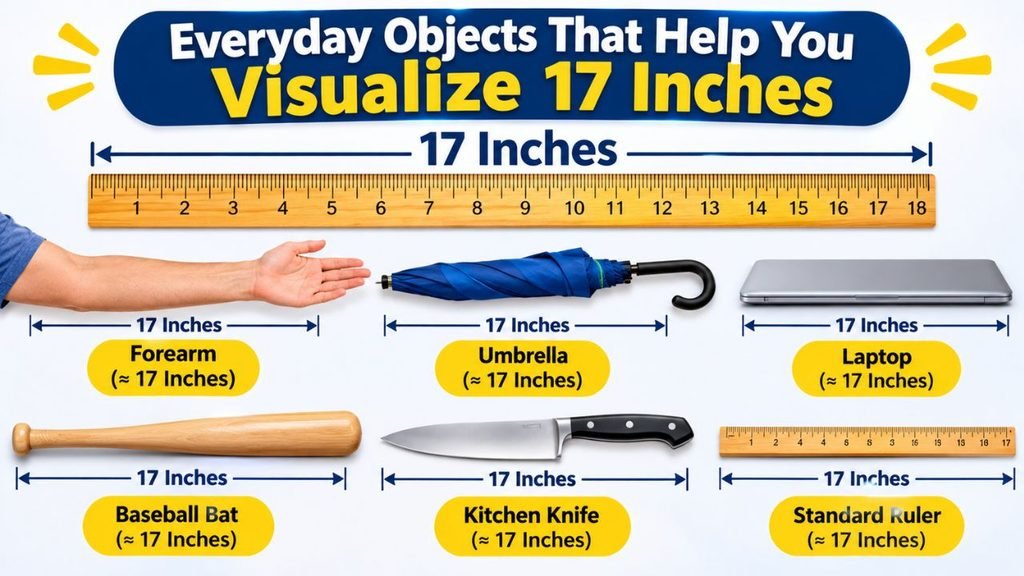
Body-part comparisons can help us understand measurements better. Familiar items may make the measurement easier to visualize. Here are a couple of daily items that will give you a little more background on how to relate measurements to other things.
A Standard 12-Inch Ruler Plus 5 Inches
A basic ruler can serve as an excellent base. By adding 5 more inches to that same ruler’s measurement, you will be left with 17 total inches. In terms of creating a physical reference, this is perhaps the most straightforward method.
A 17-Inch Laptop Screen
Laptops can be purchased with 17-inch screen size. The 17-inch screen size refers to the measurement from the upper left hand corner to the lower right hand corner. Therefore, it does not refer to how wide or tall the laptop is.
A Small Furniture Section
Certain shelves, storage areas, and/or furniture components can be approximately 17 inches long, wide, or deep. Please note that products are manufactured with different measurements. Therefore, please verify the specified length, width, or depth prior to making comparisons to other furniture pieces.
A Piece of Cardboard
Using either a ruler or measuring tape, you can create a 17-inch long mark on a piece of cardboard. The purpose of this is to provide a simple visual guide that you can position alongside your forearm or other parts of your body.
How to Convert 17 Inches Into Other Units
Converting units is helpful for comparing measurements, particularly when various types of equipment and/or items have used different measuring systems.
| Conversion | Calculation | Result |
| Inches to feet | 17 ÷ 12 | 1.4167 ft |
| Inches to centimeters | 17 × 2.54 | 43.18 cm |
| Inches to millimeters | 17 × 25.4 | 431.8 mm |
| Inches to meters | 17 × 0.0254 | 0.4318 m |
| Inches to yards | 17 ÷ 36 | 0.4722 yd |
Is 17 Inches Considered Long or Short Compared to a Human?
The answer will depend upon which body part is being compared. If the comparison is for the full height of an adult, then 17 inches is considered short. When compared to the average size of a hand, 17 inches is much larger. If the comparison is made against the length of a forearm, 17 inches could be very similar in size to what many adult forearms measure.
There is no universal body part reference for comparing 17 inches to a human being. A person’s height, age, and bodily proportion determine what the size of 17 inches appears like on them.
A more accurate method would be to use a measuring tape to compare yourself to your own physical dimensions. This provides you with your own reference point, as opposed to making assumptions about what is “average.”
How to Measure 17 Inches Against Your Body
If you wish to compare this length with your own body, then follow the instructions below:
- Choose a body part: Decide whether you want to compare the measurement with your forearm, hand, arm, or torso.
- Use a measuring tape: Place the tape at the correct starting point.
- Measure carefully: Keep the tape aligned with the section you want to measure.
- Compare the result: Check whether your measurement is shorter than, equal to, or longer than 17 inches.
Compare the arm below the elbow (forearm) by measuring from the elbow to the wrist. Measure from the wrist crease to the tip of your middle finger for hand length.
Do not expect that your measurements will be similar to anyone else’s. Because of each individual’s body proportions, your personal measurements provide the most beneficial reference.
Common Mistakes When Comparing 17 Inches to a Human
Many times people assume that all adults have 17 inch forearms. Since we have different body types, this measurement is not correct for every adult.
A second mistake people make when buying a new laptop is assuming that a computer’s screen size means how wide the computer itself is. Screen size is measured from one corner of the screen to the opposite corner of the screen (diagonally), not across the front of the computer.
In addition to being careful about confusing length with circumference, it is equally important to realize that there is a difference between a straight 17-inch measurement and having the tape wrapped around a body part. Finally, try not to rely solely upon photographs since camera angle and perspective can alter the perceived size of an object.
Using a ruler or measuring tape is the best way to check an exact measurement.
Also Read: Things That Are 30 Inches | Things That Are 8 Inches Long
Conclusion
Seventeen inches is equal to one foot five inches; forty-three point eighteen centimeters; and four hundred thirty-one point eight millimeters. As compared to the human body, it may be similar to the adult forearm length of certain individuals; however, individual measurement variations will occur.
This is longer than most adult hands, but shorter than a person’s total height. This could be used as a good reference to visualize the length of some newborn babies.
Ultimately, 17 inches compared to a human will vary based on the part of the body being compared and the body dimensions of that person. The best way to make an accurate comparison is by using a measuring device such as a ruler or measuring tape to take the measurement yourself.
FAQs About 17 Inches Compared to a Human
1. How many feet is 17 inches?
Seventeen inches equals approximately 1.4167 feet, or 1 foot 5 inches.
2. Is 17 inches similar to a human forearm?
Similar to the forearm length of many adult people. However, forearm lengths depend upon an individual’s height and body proportions.
3. Is 17 inches longer than a human hand?
Yes. Seventeen inches is much greater than the distance between an individual’s wrist crease and the end of their middle finger when they are an adult.
4. How does 17 inches compare with adult height?
For a person with a height of 5’8″, 17″ would equal 25% of that person’s overall height. This percentage will change based on how tall the person is.
5. What is the easiest way to visualize 17 inches?
Imagine a 12-inch ruler that has an additional five inches attached to it. Alternatively, imagine a straight line that is 43.18 centimeters long.