

Taking hold of a Coke can is most likely something you do unconsciously. It’s just a small cylinder of aluminum that fits snugly in your hand or inside the door of the fridge and in virtually any cup holder ever invented. But people still want to know Coke can dimensions. Designers are looking for the dimensions of a Coke can for mockups, teachers of math need them for their lessons, artists need the dimensions for their work, and customers want to know if the box will fit the shelf.
This article will provide you with the specifications of a 12-ounce can and will help you compare it against other types of cans used around the world, as well as determining what these numbers mean. The numbers are presented in tables, and you may find explanations of the numbers in the accompanying text. Cans can come in different designs depending on the country and the time they were produced, so it may be better to treat the information we provide here as indicative rather than precise, and take the measurements of your own Coke can.
Overview of the Regular Coke Can
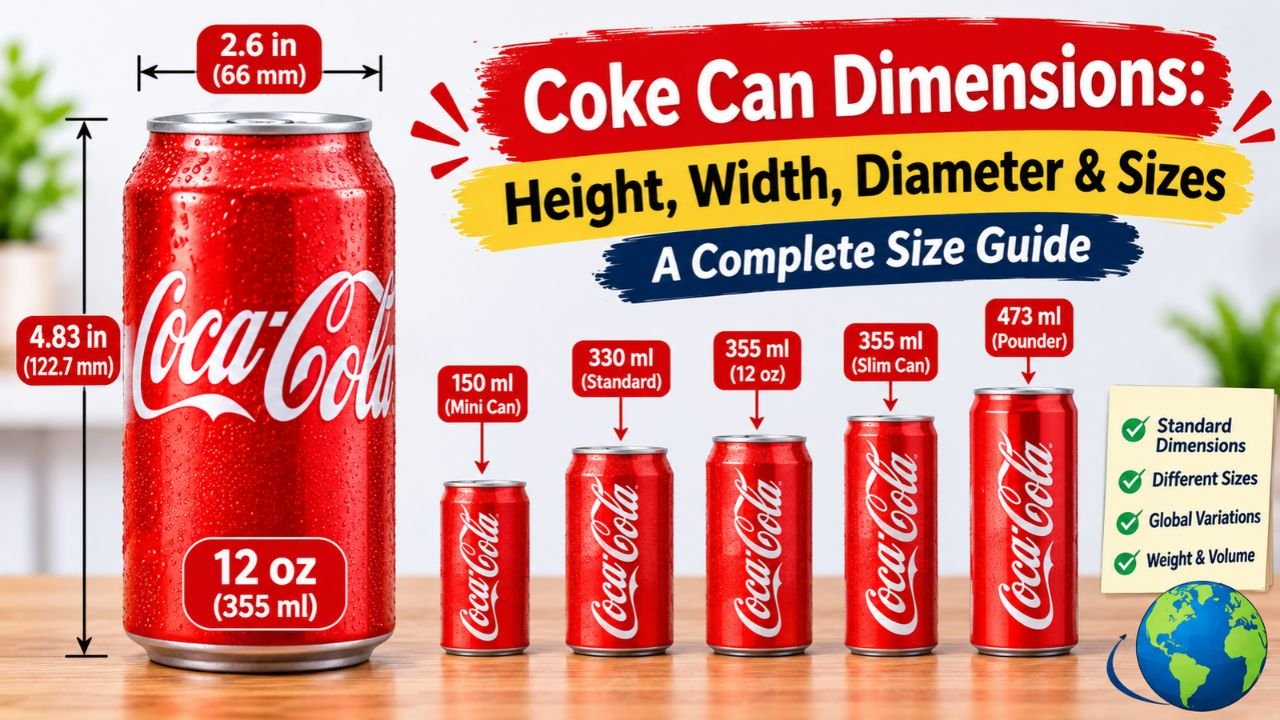
Most of the time when people ask about Coke can dimensions, they are referring to the 12 fl oz (355 ml) aluminium can that is sold throughout the United States as well as in some other regions. Its dimensions are similar, so it is easy to handle it in vending machines and coolers and while packaging.
Standard 12 oz (355 ml) can
| Measurement | Imperial | Metric |
| Height | 4.83 in | 122.7 mm |
| Body diameter (widest point) | 2.6 in | 66 mm |
| Top diameter (narrowed neck) | 2.13 in | 54 mm |
| Circumference of body | About 8.17 in | About 20.7 cm |
| Liquid volume | 12 fl oz | 355 ml |
| Empty weight (approx.) | About 0.5 oz | About 14 g |
| Full weight (approx.) | About 13.4 oz | About 380 g |
| External cylinder volume (approx.) | About 25.6 in³ | About 420 ml |
Some of the figures deserve mention. Circumference is obtained by multiplying the body diameter by pi. External volume is obtained if a can is considered a perfect cylinder. This figure is greater than 355 ml, as the can has a form space at the top, the bottom is curved and the walls are metal, meaning that the fluid won’t take up the whole form. The weights are approximate because cans differ a little in thickness from one factory to another.
Reasons for the Narrow Top of the Can
Looking at a can from the side, anyone would notice that its top is narrower than its body part. The neck tapering is part of Coke can dimensions, making the can more practical for use.
- The lid is made of less metal. The heaviest and thickest part of the container is its lid, so a smaller lid means less money spent to make a billion cans.
- Strength. The neck that is narrower contributes to the fact that the can is able to resist the high pressure that is applied to the airy drink.
- Stacking. The shape of the can’s body makes it easier to stack it on one another.
- Comfortable drinking. The process of drinking is more convenient due to the smaller mouth of the can.
The bottom of the can is domed, which increases the structure’s strength.
Dimensions of Coke Cans
The 12-ounce Coke can is the most widespread can size all over the world, but it is not the only one. Different countries and manufacturers produce their own can sizes and forms.
Common can sizes compared (approximate)
| Can type | Volume | Approx. height | Approx. diameter |
| Mini can (150 ml) | 150 ml | 3.48 in (88 mm) | 2.1 in (53 mm) |
| Mini can (7.5 oz) | 7.5 fl oz (222 ml) | About 4.5 to 4.75 in | About 2.1 to 2.5 in |
| Standard metric can | 330 ml | About 4.5 in (115 mm) | 2.6 in (66 mm) |
| Standard US can | 12 fl oz (355 ml) | 4.83 in (122.7 mm) | 2.6 in (66 mm) |
| Sleek or slim can | 12 fl oz (355 ml) | About 6.1 in (155 mm) | About 2.25 in (57 mm) |
| Large “pounder” can | 16 fl oz (473 ml) | About 6.2 in (157 mm) | About 2.6 in (66 mm) |
| Large metric can | 500 ml | About 6.6 in (168 mm) | 2.6 in (66 mm) |
The dimensions of the mini-can are different from source to source; therefore, take measurements for an accurate dimension. Several mini-can sizes have a similar body diameter of approximately 2.6 inches. This was done intentionally. Having a consistent body diameter allows manufacturers to use the same lid, tool and vending machine mechanisms for each size, while changing only the length of the product. An individual who compares Coke can dimensions for various sizes will recognize this relationship quickly.
Coke Can Sizes Around the World
In the United States, 12 oz. cans are standard. However, some areas chose to use different sizing options. Many countries adopted metric measurements, which resulted in rounding of the can sizes. Other regions used their own preferences to determine what size they would produce.
Typical can sizes by region
| Region | Common can size (approx.) |
| United States | 12 fl oz (355 ml) |
| United Kingdom | 330 ml |
| Much of Europe | 330 ml, plus 250 ml slim cans |
| Australia | 375 ml |
| India | 250 ml and 300 ml |
Coke can dimensions vary depending on where you purchase your soda. In addition, some stores offer multiple size options simultaneously. Therefore, when purchasing a coke can, always make sure to read the label. The main thing to remember is that coke can dimensions are not the same globally. For example, a 330 milliliter can will be smaller in height than a 355 milliliter can. As such, a holder/tool designed for one size may not fit the other size.
Why 12 Ounces?
The 12 oz. size became an industry standard for drink containers in the U.S. during the last half of the 20th century because it provided the best balance between price, portion size, and ease of handling. Once vending machines and refrigerator shelves were designed around this size, it was difficult to alter. Most metric system countries adopted either 330 ml or another similar rounded number. Consequently, most individuals grew up drinking from either 355 ml or 330 ml containers and seldom realized how slightly different they were.
Will It Fit? Practical Checks
Knowing the width and height of a coke can will help answer daily fit issues. The standard coke can has a width of 2.6 inches, therefore, whatever will be holding the can must have an opening slightly larger than the width of the can.
- Cup holders: Most would accommodate a standard can but they also fit thinner cans without trouble. A 500 ml can may fit a typical holder too, unless it is particularly tight.
- Refrigerator door shelves: A standard can fits most doors but taller cans may require shelves with more height.
- Bags and bike bottle cages: Often cage designed for bottles would fit cans poorly so check before you buy one.
- Koozies and can holders: Such products were designed for the regular can size so slimmer types may not work well.
- Desk organisers: A can diameter gives you an idea about possible size of an organiser since quite a few of them have an opening about 6 to 7 cm.
Packing Arithmetic
A retailer or event organizer will frequently have to figure out what volume of space a case of canned goods occupies. Since each can has a body diameter of 2.6 inches, you may use basic multiplication to calculate this. All figures listed below represent cans positioned on end in a rectangular pattern; however, do not take into consideration the packaging, which would increase the size slightly.
Footprint of cans arranged in a grid (theoretical minimum)
| Arrangement | Width | Length | Height |
| 1 can | 2.6 in | 2.6 in | 4.83 in |
| 4 cans in a row | 10.4 in | 2.6 in | 4.83 in |
| 6 cans in a row | 15.6 in | 2.6 in | 4.83 in |
| 12 cans (3 × 4) | 7.8 in | 10.4 in | 4.83 in |
| 24 cans (4 × 6) | 10.4 in | 15.6 in | 4.83 in |
Actual cartons have a greater size due to the cardboard material and the fact that cans are not true cylinders. Carns are often piled in staggered patterns to maximize storage efficiency, which is one reason the dimensions shown on cartons may differ from the dimensional calculations. But the numbers give us an idea of Coke can dimensions, and it can be translated into efficiency in space and volume.
Converting the Measurements
Many projects require both inches and millimeters. The chart below will convert the key numbers using the conversion rate of 1 inch to 25.4 mm.
Quick conversion of key measurements
| Inches | Millimetres | Centimetres |
| 2.1 | 53.3 | 5.3 |
| 2.13 | 54.1 | 5.4 |
| 2.25 | 57.2 | 5.7 |
| 2.6 | 66.0 | 6.6 |
| 3.48 | 88.4 | 8.8 |
| 4.83 | 122.7 | 12.3 |
| 6.1 | 154.9 | 15.5 |
| 6.2 | 157.5 | 15.7 |
A short-cut to convert from inches to centimeters is to take your inch measurement and multiply it by 2.54. This will give you the centimeter equivalent. For example, 4.83 inches equates to approximately 12.3 cm. If someone asks you what are the dimensions of a soda can in metric units, this would be the most efficient method.
Uses for Coke Can Dimensions
Surprisingly, a lot of people rely on these numbers.
- Packaging and Product Design: It is used for mockups, labeling, and holders.
- Education: It is used for teaching volume, surface area, and unit conversion.
- Crafts and DIY: Maker’s who are making can-based lamps, planters, or organizers will need both the diameter of the can and its height.
- 3D Printing: Users create Can Holders, Coasters, and Stands using Measurements.
- Use in Retail and Logistics: The accurate size of a can is necessary for planning shelves and corrugated boxes.
- Photography and film: Props departments match can sizes for realistic scenes.
Coke can dimensions will determine how effective each of these functions is. Therefore, a handy, dependable source for this information would be beneficial.
A Maths Lesson in a Can
The can provides an excellent example for teaching in the classroom since its numbers relate to each other well. A body diameter of 2.6 inches translates into a radius of 1.3 inches. By taking the product of pi times the radius squared times the height, you get the total volume of the outside, or about 25.6 cubic inches, which is equivalent to approximately 420 ml.
There is only 355 ml of liquid inside; therefore, the remaining amount is what we call the “headspace,” plus the metal and the curved edges. Students can take measurements of an actual can and compare them to the calculated values to determine how accurate the calculations were. This makes the dimensions of a Coca-Cola can an interesting way to apply geometry concepts in the real world.
Also Read: Red Bull Can Sizes | White Claw Sizes | Celsius Can Dimensions
Conclusion
Although the coke can dimensions may seem insignificant, they actually form an essential part of the process of how drinks are packaged, stored and transported. A conventional 12 oz can is 4.83 inches in height and 2.6 inches in diameter, and its neck tapers down to 2.13 inches, however different sizes would use the same diameter but differ in height. Once you learn the secrets of using these dimensions you will not find it difficult to compare different types of the coke can.
If you are a designer, teacher, or amateur who would like to have a useful reference, feel free to use the tables of Coke can dimensions, and in case you need very precise results, you may refer to the actual can measurements.
FAQs About Coke Can Dimensions
1. What is the height of a Coke can in centimeters?
Standard 12 oz cans usually measure about 12.3 cm.
2. What is the size of a Coke can?
Coke cans are about 6.6 cm in diameter at the widest part.
3. Are both 330 and 355 ml cans same in size?
No. The 330 ml can is slightly shorter, around 115 mm, but both cans have about the same diameter of 66 mm.
4. What is the weight of a Coke can?
Weight of a full Coke can is around 380 g while empty can weighs approximately 14 g.
5. Do coke cans differ in size across different countries?
Coke can sizes and measurements vary from one country to another, as US Coke cans are 12 oz while cans in UK and most of Europe measure around 330 ml.