

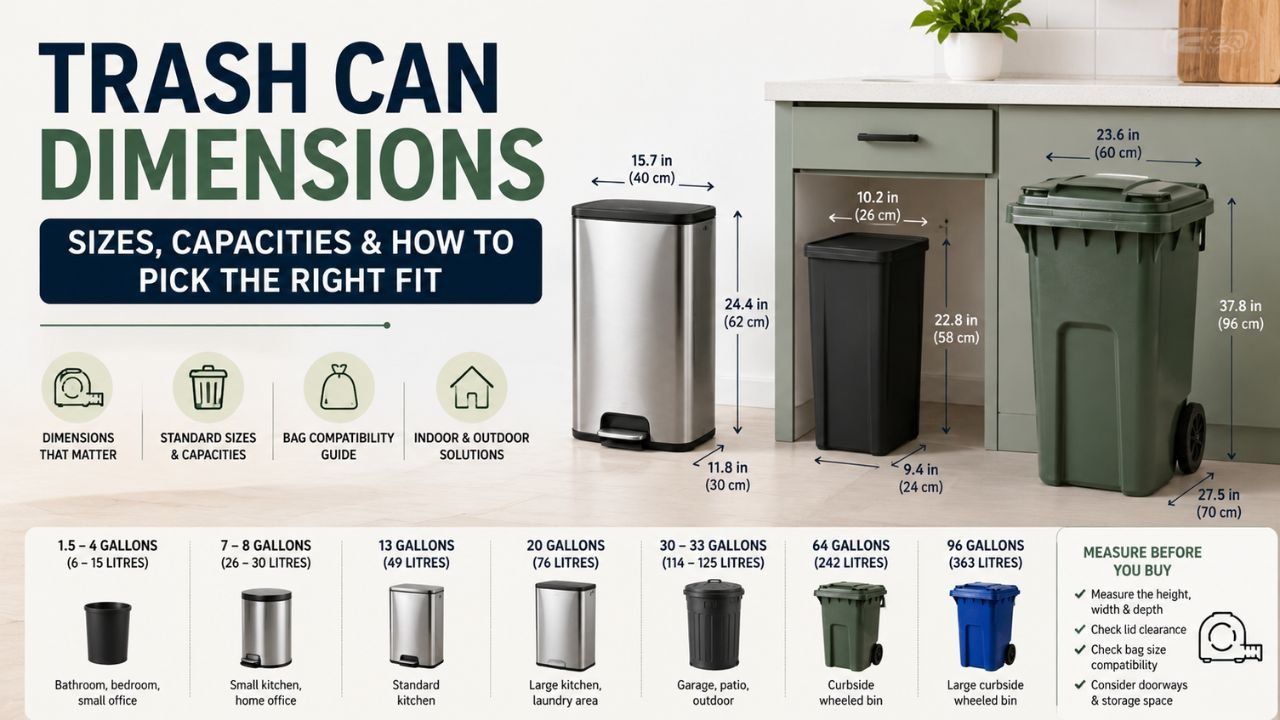
The simplest item in your home seems to be the trash can, until you go to purchase a replacement. Your kitchen cabinet is too narrow by 2 inches, the lid won’t open when placed beneath the counter top, and/or the new bags slip from the rim. All of those issues are due to one issue: no one measured their trash can dimensions prior to purchasing.
This guide provides information regarding the size of the objects that may be encountered in home, office, and on-street settings; how capacity (gallons/litres) relates to physical measurement; and how to select a can based upon the available space and type of bag used. The data is presented in tabular form with accompanying explanatory text. Since each manufacturer creates its own mold, the numbers contained herein should be viewed as general parameters, and consumers should physically assess the item prior to making a purchase decision.
Why Trash Can Dimensions Matter
Trash cans come in many different shapes and sizes, and while the “capacity” gets most of the focus on a trash can label, it’s actually the “height,” “width” and “depth” that determine if the can will function properly in your everyday life. Below are some examples of how mismatching trash can dimensions can lead to problems:
- A can that fits the floor space but not the cabinet door opening
- A step-on can whose lid hits the underside of the counter
- Bags that are too narrow to stretch over the rim or too long and wasteful
- A wheeled bin that does not fit through a gate or side passage
- A curbside bin that is too large for the storage corner you planned
- A few minutes of measuring prevents almost all of them.
Capacity: Gallons and Litres
Trash containers are sold according to their size (capacity). Countries have different systems of measurement. For example, in America trash containers are sold based on gallons; however, in most other countries, they are sold based on liters. One U.S. gallon is equal to approximately 3.785 liters. Therefore, converting from gallons to liters is simply multiplying the number of gallons by 3.785.
Common capacities and typical uses
| Size (US gallons) | Approx. litres | Typical use |
| 1.5 to 4 | 6 to 15 | Bathroom, bedroom, small office |
| 7 to 8 | 26 to 30 | Small kitchen, home office |
| 13 | 49 | Standard kitchen can |
| 20 | 76 | Large kitchen, laundry area |
| 30 to 33 | 114 to 125 | Garage, patio, outdoor |
| 44 | 167 | Heavy household use, commercial |
| 55 | 208 | Industrial and large outdoor |
| 64 | 242 | Curbside wheeled bin |
| 96 | 363 | Large curbside wheeled bin |
A thirteen-gallon size is the household standard as well as a match for the common “tall kitchen” bag, and therefore many kitchen can capacities fall within this range. When you shop, be aware that the stated capacity of the can is nominal. The usable space below the rim is frequently slightly smaller.
Also Read: Coke Can Dimensions | Red Bull Can Sizes | Monster Can Dimensions
Indoor Trash Can Dimensions
Indoor cans are available in numerous forms such as; round, rectangular, slender, and half-round styles that fit flush to a wall. Due to the variation in the physical shape of the can, the footprint of each will differ significantly even if both cans contain the exact same volume of waste.
Typical indoor can sizes (approximate)
| Capacity | Typical height | Typical width | Typical depth or diameter |
| 1.5 to 2 gal (bathroom) | 8 to 10 in (20 to 25 cm) | 7 to 8 in (18 to 20 cm) | 6 to 8 in (15 to 20 cm) |
| 3 to 4 gal | 11 to 13 in (28 to 33 cm) | 9 to 10 in (23 to 25 cm) | 8 to 10 in (20 to 25 cm) |
| 7 to 8 gal | 17 to 19 in (43 to 48 cm) | 12 to 14 in (30 to 36 cm) | 10 to 12 in (25 to 30 cm) |
| 13 gal, slim rectangular | 23 to 25 in (58 to 64 cm) | 15 to 17 in (38 to 43 cm) | 10 to 12 in (25 to 30 cm) |
| 13 gal, round | 23 to 25 in (58 to 64 cm) | 16 to 17 in (41 to 43 cm) | 16 to 17 in (41 to 43 cm) |
The bottom two lines. A thin rectangular 13-gallon trash can and a circular 13-gallon trash can are capable of holding approximately equal amounts of waste, however the circular trash can uses more of the floor. If you have a small kitchen, the rectangular version may be a much better fit for you, as this is an excellent illustration as to why trash can dimensions is more important than simply its volume.
Step-On and Sensor Cans
The use of pedals, motion sensors, or tall lids on cans requires more room. When using a pedal-operated can there must be enough space above the top of the can so that the lid can swing open. This usually requires an additional six to twelve inches of clearance. Motion sensor cans will also require more space in front because they have a larger motor/battery housing on the back of the can. It is always best to find out the measurements from the manufacturer with the lid of the can being open, rather than just closed.
Outdoor and Wheeled Trash Can Dimensions
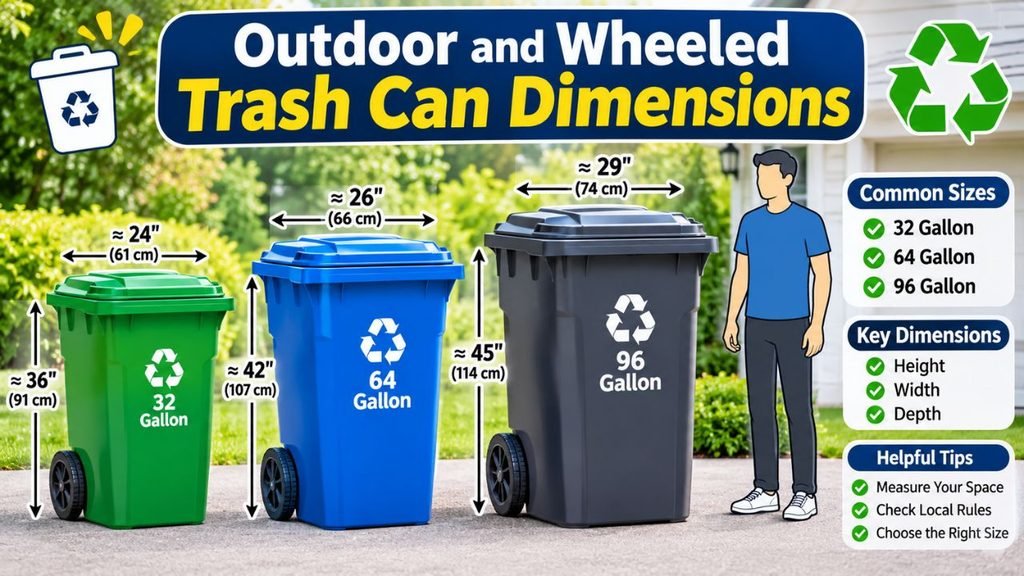
Because outdoor containers are typically bigger than indoor containers and require moving to the curb, they should have wheels and handles. In most cases, local trash collection agencies will provide you with a container. Most outdoor containers come in four different sizes: 32-gallon, 48-gallon, 64-gallon, and 96-gallon.
Typical outdoor and wheeled bin sizes in the US (approximate)
| Capacity | Typical height | Typical width | Typical depth |
| 20 gal, round non-wheeled | 26 to 28 in (66 to 71 cm) | 19 to 20 in (48 to 51 cm) | 19 to 20 in (48 to 51 cm) |
| 32 gal, round non-wheeled | 27 to 28 in (69 to 71 cm) | 22 in (56 cm) | 22 in (56 cm) |
| 32 gal, wheeled | 37 to 39 in (94 to 99 cm) | 20 to 22 in (51 to 56 cm) | 24 to 26 in (61 to 66 cm) |
| 64 gal, wheeled | 42 to 44 in (107 to 112 cm) | 24 to 27 in (61 to 69 cm) | 28 to 33 in (71 to 84 cm) |
| 96 gal, wheeled | 43 to 47 in (109 to 119 cm) | 29 to 31 in (74 to 79 cm) | 34 to 37 in (86 to 94 cm) |
Wheeled bins are tall and deep. They require an unobstructed path from where you store them to the street. Prior to purchasing a 96 gallon bin, take measurements of the narrowest point of access to get the bin from your yard to the street (e.g., a gate, space next to the house). You should add some extra inches to allow for the handles of the bin as well as for you to be able to reach inside of it.
Metric and International Bin Sizes
Outside the U.S., bins are generally given in liters. Many councils in the U.K., Europe, Australia and elsewhere have a standard size of wheelie bin, and the measurements of these bins tend to be fairly consistent regardless of who manufactures them.
Typical wheelie bin sizes in metric units (approximate)
| Capacity | Typical height | Typical width | Typical depth |
| 120 litres | About 93 cm (37 in) | About 48 cm (19 in) | About 55 cm (22 in) |
| 240 litres | About 107 cm (42 in) | About 58 cm (23 in) | About 73 cm (29 in) |
| 360 litres | About 110 cm (43 in) | About 62 cm (24 in) | About 87 cm (34 in) |
| 1,100 litres (commercial) | About 137 cm (54 in) | About 107 cm (42 in) | About 136 cm (54 in) |
Notice that the metrics and American units of measurement for trash cans are very close. A 240-liter trash can is essentially equivalent to a 64-gallon trash can, and a 360-liter trash can is approximately the same as a 96-gallon trash can. Therefore, when you compare products from different countries, you will be able to easily convert the measurements of trash cans between the two systems.
How to Measure Your Space
A few minutes with a tape measure prevents most mistakes.
- Take measurements of the width, depth and height of the space where you plan on sitting your can.
- Account for lid space. Measure the amount of clearance in the vertical direction (not just the horizontal) to find the size of your space.
- Measure the size of your doors. If you have under-sink cabinets, measure the opening of the cabinet, not just the inside of the cabinet.
- Check the path. For wheeled bins, measure gates, steps and tight turns.
- Add a margin. Leave one to two inches on each side so the can can be removed without scraping.
- Read the listing of the product. Confirm if the listed size of the garbage bin includes the lid, handles, and wheels.
Matching Bags to Trash Can Dimensions
A bag that is too small for a can will slip down into it, while a bag that is too big will slide around the outside edge of the can.
A good guideline for choosing a garbage bag is to use one with a flat width that is equal to or greater than one-half of the inside circumference of the can. The length of the bag needs to extend from the top of the can down past the bottom of the can by an amount that includes the height of the can, one-half of the width of the bottom of the can, and a couple of extra inches for overhang at the top.
Formulas for volume and bag sizing
| What you want | Formula | Worked example |
| Volume of a round can (gallons) | π × (diameter ÷ 2)² × height ÷ 231 | 16 in wide, 24 in tall gives about 20.9 gal (outer measurement) |
| Volume of a rectangular can (gallons) | Length × width × height ÷ 231 | 12 × 15 × 24 in gives about 18.7 gal (outer measurement) |
| Litres from US gallons | Gallons × 3.785 | 13 gal gives about 49 L |
| Minimum bag width | Half of the can’s perimeter | 16 in round can has a perimeter of about 50 in, so width of at least 25 in |
| Minimum bag length | Can height + half the bottom width + 3 to 4 in | 24 + 8 + 4 gives about 36 in |
The volume formulas provide an upper bound on what could theoretically be held inside the can. Because of the way cans are made (tapered sides, rims and thickness), they will always have less usable space than their theoretical maximum. For example, if you calculate that your can holds 20 gallons of water, the label might only state that it holds 13 or 16 gallons.
You should use the volume formulas to help you determine how much larger one can is than another; do not rely on them to tell you exactly what will appear on the label. Volume formulas are also a good tool to verify trash can dimensions provided by a manufacturer in a product description.
Choosing by Room
A quick guide to matching sizes to spaces.
- Bathroom: 1.5 to 4 gallons. Look for a slim can that fits beside the toilet.
- Bedroom and office: 3 to 8 gallons. Small, lidded designs hide the contents.
- Kitchen: Thirteen gallons are generally accepted as the average size. Slim rectangular designs can help reduce the amount of floor space used, and under-counter pull-out designs would work well with cabinetry.
- Laundry and garage: 20 to 33 gallons, preferably with a lid and sturdy handles.
- Outdoors/Curbside: 32-96 Gallon size, features wheels, a locking lid for pest control.
- Recycling: Use a recycling container that matches the size of what is picked up at your house, and try putting two of those containers next to each other.
Also Read: King Size Blanket Dimensions | Stairs Dimensions | King Size Bed
Conclusion
Trash can dimensions help with the guesswork when purchasing a trash can. The amount of waste a can can hold is indicated by its capacity, while the trash can dimensions (height, width, depth) and the clearance around the lid of the trash can indicate if the trash can will fit into your cabinet, corner, or gate. With just some basic math skills and a few measurements, you can avoid many mistakes.
Take measurements of the area where you want to place the trash can; review the measurements provided on the packaging for accuracy; and select bags that fit inside the trash can. Now, when you look at all of those different bin options, you’ll be able to quickly determine which numbers are important to consider, as trash can dimensions is the most important factor in determining if a trash can will work well within your home.
FAQs About Trash Can Dimensions
1. How big is a 32-gallon trash can?
The 32-gallon can with no wheels is approximately 27-28 inches tall and 22 inches across. The wheeled version is both higher and deeper, with an approximate height of 37-39 inches.
2. What are the dimensions of a 96-gallon bin?
The typical height of these units is 43-47″, the width is 29-31″, and the depth is 34-37″. However, the actual size may differ depending on which company manufactured it.
3. How many litres is a 13-gallon trash can?
About 49 litres.
4. Are metric and US bin sizes equivalent?
Approximately. A 240-litre bin is equivalent to approximately a 64 gallon bin, and a 360 litre bin is equivalent to approximately a 96-gallon bin.
5. Do trash can dimensions include the lid?
Sometimes. Check the product page for details about how the height of the item was measured (with the lid shut or extended), and if the measurement includes the wheels/handles.