

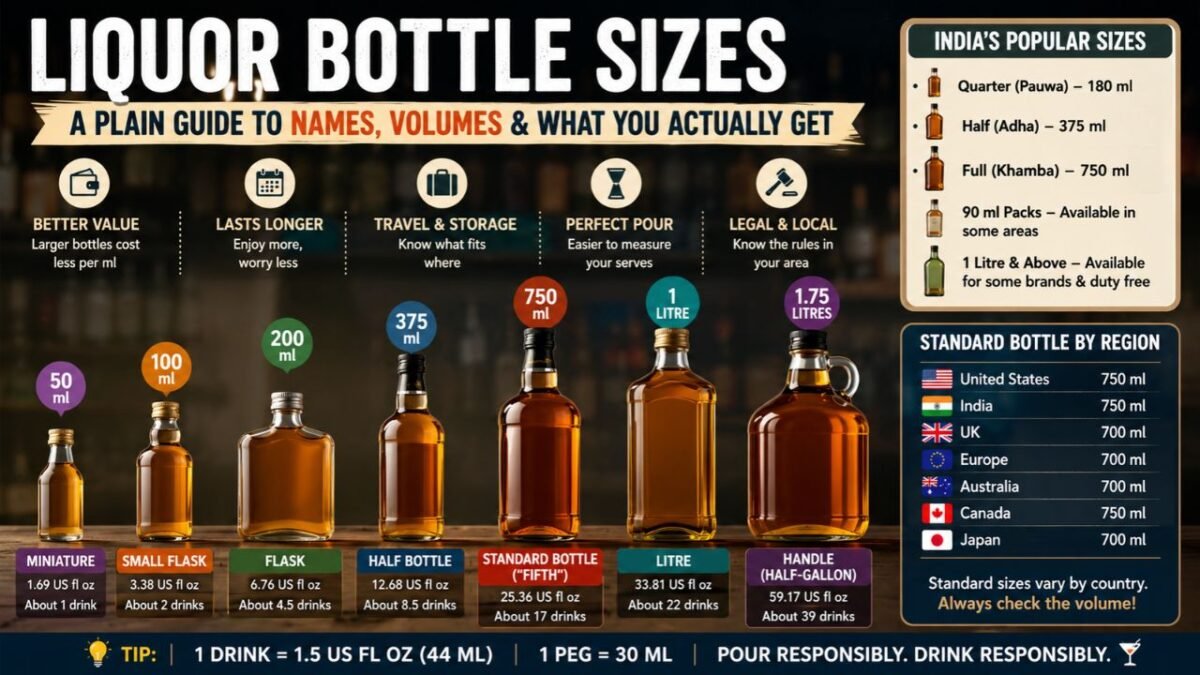
Whenever you step into any liquor store, you will find the same liquor in many different forms. For instance, there’s the travel-size bottle that fits into your pocket, there’s the standard bottle that is located in the mid-shelves, and there’s the huge bottle that takes up 2 hands. Every type of bottle has its name, its pricing structure, and the number of drinks it contains.
In this guide, liquor bottles are presented in terms of their sizes in the USA, India, and other countries. It gives information on metric volumes, liquor bottle sizes, the number of drinks in each bottle, and the new parameters of measuring alcohol vs. old ones. The notes are in tabular form, and the writing gives the details of the sizes in question. Laws governing liquor bottle sizes are country- and, perhaps, state-specific, and even before making a purchase of liquor, one needs to be sure of the necessary sizes they need to buy.
Why Liquor Bottle Sizes Matter
Bottle size affects more than the price tag. It decides:
- The amount of money you spend on each drink will vary because larger-sized bottles are generally less expensive per milliliter.
- How long a bottle lasts and how fresh the last pour tastes
- What fits in your bar cart, fridge door, or luggage?
- How easy it is to pour measured servings
- What you can legally buy or carry in your state or country
Understanding the liquor bottle sizes can help you make many choices about how much to buy, what to stock your home bar with, and even how much alcohol to plan for an event.
The Standard Sizes and Their Nicknames
Most of the spirits available in the modern world are sold in metric volumes. Each size tends to have a nickname attached to it, which is used by shopkeepers and consumers alike. In the USA, metric sizes were introduced in 1980 and replaced older measures such as a fifth or a pint. Below is a table describing commonly used sizes and the approximate number of servings that each size contains.
Common spirit bottle sizes and servings
| Size | Common nickname | US fluid ounces | Drinks at 1.5 oz (44 ml) | Pegs at 30 ml |
| 50 ml | Miniature, nip, mini | 1.69 | About 1 | About 1.7 |
| 100 ml | Small flask | 3.38 | About 2 | About 3.3 |
| 200 ml | Flask, half-pint | 6.76 | About 4.5 | About 6.7 |
| 375 ml | Half bottle, pint | 12.68 | About 8.5 | 12.5 |
| 750 ml | Standard bottle, “fifth” | 25.36 | About 17 | 25 |
| 1 litre | Litre | 33.81 | About 22 | About 33 |
| 1.75 litres | Handle, half-gallon | 59.17 | About 39 | About 58 |
A couple of comments on the table. The “Drinks” column has been calculated using the US standard pour of 1.5 fl oz (approx. 44 ml), and the “Pegs” column has been calculated using a 30 ml peg, a typical bar measure in India. Of course there are many different pours, and even some bars use 60 ml or larger measures. Of all the different liquor bottle sizes available, by far the most widely used is the 750ml bottle, and this sits in the middle of almost every range globally.
Liquor Bottle Sizes in India
India uses its own unique naming convention for these items. The liquor bottle sizes listed below are what you will generally find available in stores and bars throughout India; however, depending on the state and/or local laws, the availability of specific sizes may be restricted, and some states may restrict the use of certain sizes.
- “Quarter” or “pauwa”: 180 ml, the smallest bottle that is used for IMFL (Indian Made Foreign Liquor).
- Half or “adha”: 375 ml, a middle size popular for sharing.
- Full bottle or “khamba”: 750 ml, the standard size for most brands.
- 90 ml packs: These can be purchased in some areas as small bottles or other forms, however, there may be restrictions or bans on purchasing these in certain areas.
- 1 liter and above: Available for some brands, and also in duty-free stores; however, this size is not as common as other sizes in most standard retail establishments.
The most common beer container sizes are 330ml, 500ml and 650ml bottles/cans. In India, the largest of these (650 ml) is the most widely purchased.
The three main size bottles used in India for alcoholic beverages (quarter, half, and full) are what matter most to those drinking, and most consumers know these before they understand how to read the milliliter amounts on the label.
Also Read: White Claw Sizes | Red Bull Can Sizes | Coke Can Dimensions
Regional Standard Sizes
The “standard bottle” varies from country to country. As a result, when comparing prices, you may find that the volume of the standard bottle used in each country differs, making it difficult to compare prices. This can be especially true if you are traveling internationally, as the size of the bottle you purchase will depend on what country you visit.
Typical standard spirit bottle by region
| Region | Typical standard bottle | Other common sizes |
| United States | 750 ml | 50 ml, 200 ml, 375 ml, 1 L, 1.75 L |
| India | 750 ml | 180 ml, 375 ml, sometimes 90 ml or 1 L |
| United Kingdom | 700 ml (70 cl) | 350 ml, 200 ml, 1 L, 5 cl miniatures |
| European Union | 700 ml | 350 ml, 200 ml, 1 L |
| Australia | 700 ml | 200 ml, 350 ml, 1 L |
The 750ml size of bottle is popular in both the USA and India; however, the UK, the European Union (EU) and Australia prefer 700 ml bottles. This 50 ml difference is relatively small; however, it can have an impact on price comparisons: A 700 ml bottle contains approximately 6.7% less alcohol than a 750 ml bottle when compared at the same alcoholic strength; therefore, please be sure to verify the volume of each bottle before comparing prices among different nations.
Old Measures Versus Metric
A pint, quart, and gallon were used as units of measurement for American bottles before metric sizes came along. These terms have remained in use throughout society and can be heard today when someone refers to a 750ml bottle as a “fifth” despite the fact that a 750ml bottle does not contain exactly one fifth.
Old US measures and their metric equivalents
| Old measure | Volume in US fluid ounces | Approx. millilitres | Closest modern size |
| Half pint | 8 | 237 | 200 ml |
| Pint | 16 | 473 | 375 ml or 500 ml |
| Fifth (four-fifths of a quart) | 25.6 | 757 | 750 ml |
| Quart | 32 | 946 | 1 litre |
| Half gallon | 64 | 1,893 | 1.75 litres |
The fifth was 1/5 of a U.S. Gallon (approx. 757 ml) therefore, 750 ml is slightly less than a fifth. This modification was made in order to be compatible with the metric system; this explains why previous writings about alcohol bottles use terminology for measurements that are now obsolete. If you read previous writings regarding liquor bottle sizes, you will find these terms.
How Big Is a Bottle in Real Life?
The amount of space a product takes up is just one aspect of its overall footprint. When determining how much space a rack will take up on a floor, packing a bag with items, or deciding on shelf placement for products, you will need to determine the actual dimensions. The ranges provided below are typical due to the variability in shape among different manufacturers and product designs.
Approximate dimensions of common bottles
| Size | Approx. height | Approx. diameter |
| 50 ml miniature | 3 in (7.5 cm) | 1.4 in (3.5 cm) |
| 200 ml flask | 5.5 to 6 in (14 to 15 cm) | 2.3 in (6 cm) |
| 375 ml | 7.5 to 8.5 in (19 to 22 cm) | 2.6 in (6.5 cm) |
| 750 ml | 11 to 12 in (28 to 31 cm) | 3 to 3.3 in (7.5 to 8.5 cm) |
| 1 litre | 11.5 to 13 in (29 to 33 cm) | 3.3 to 3.8 in (8.5 to 9.5 cm) |
| 1.75 litres | 12.5 to 14 in (32 to 36 cm) | 4.3 to 4.7 in (11 to 12 cm) |
The way a bottle looks will affect how much space it takes up. For example, if a bottle has a square shape, it will be wider on the shelf. If the bottle is very tall and thin, there will be less vertical room. Also, if there is a decorative stopper on the bottle, the overall height of the bottle will increase. Many people are surprised to discover that a one-liter bottle is only slightly taller than a 750-milliliter bottle; however, the one-liter bottle is wider.
Large Formats
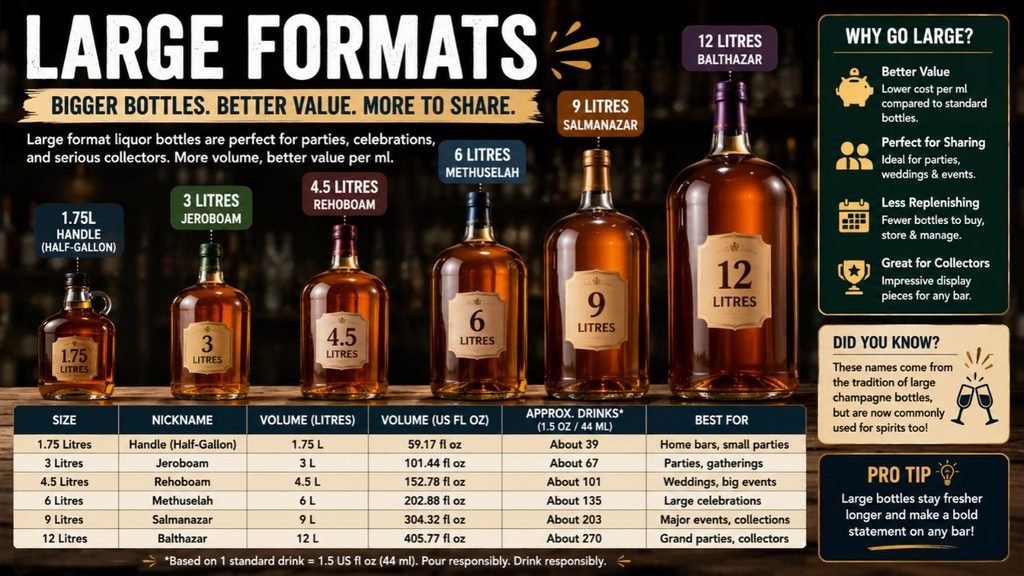
The other extreme is large bottles, primarily employed for wine and champagne, though on occasion for spirits as display items. These bottles have names derived from biblical monarchs; however, the name used to designate a volume may differ among regions because Champagne and Bordeaux utilize somewhat different systems.
Large bottle formats (wine and champagne naming)
| Name | Volume | Equivalent in standard 750 ml bottles |
| Magnum | 1.5 litres | 2 |
| Double magnum | 3 litres | 4 |
| Jeroboam (Bordeaux) or Rehoboam | 4.5 litres | 6 |
| Methuselah | 6 litres | 8 |
| Salmanazar | 9 litres | 12 |
| Balthazar | 12 litres | 16 |
| Nebuchadnezzar | 15 litres | 20 |
There are regional differences when it comes to naming conventions for bottles of alcohol. A Jeroboam is 3 liters in Champagne, while it is 4.5 liters in Bordeaux. Therefore, make sure you look at the label to find out what size bottle you actually have. While large-format bottles are less common than standard liquor bottles used on an everyday basis, they are often used during weddings, parties, and other special occasions.
How Many Drinks Are in a Bottle?
Most individuals would like to have this particular question answered. The proper response is based upon the amount of coffee used in the process. Some general guidelines are as follows:
- A 750 milliliter bottle can hold approximately seventeen standard United States drinks (1.5 ounces each), twenty-five pegs (30 milliliters each), or twelve pegs (60 milliliters each).
- A 375 ml bottle has a capacity of approximately 8 US drinks, or 12 pegs of 30 ml each, or about 6 pegs of 60 ml.
- A 180 ml quarter holds about 4 US drinks, 6 pegs of 30 ml or 3 pegs of 60 ml.
- A 1.75-liter bottle holds about 39 US drinks.
The numbers shown here should be used only as a guide when deciding what amount of alcohol to purchase and consume. The rate at which an individual will experience the effects of drinking depends on several factors including strength of the drink, body weight, the presence of food in the stomach, and the amount of time that passes between drinks.
Tips for Buying the Right Size
A few practical points can save money and avoid waste.
- A smaller size will work well for single-use purposes: either a quarter (1/4) or half (1/2). For ongoing usage in the household, and for larger events/gatherings, a 750 ml or 1 liter bottle is appropriate.
- The price of each milliliter can be calculated by dividing the total price of a bottle of product by its volume. Although larger bottles typically have lower prices per milliliter, this is not always true.
- Think about how long your drink stays fresh. Once you open a bottle of spirit, it will stay good for quite some time, but if you open a bottle of liqueur, vermouth, or cream-based drink, it won’t last as long. So, using smaller bottles makes more sense for these types of beverages.
- Check your area’s laws. Different states may limit the size of bottles you can bring in, and each state has different regulations on taking bottles into other states.
- Try out the product with miniatures before purchasing. For a minimal cost, you can utilize a 50ml sample to experience a previously unused brand.
- Measure your storage. Make sure the bottle fits your shelf, door, or bar cart.
Also Read: Monster Can Dimensions | Pringles Can Size | King Size Bed
Conclusion
To understand liquor bottle sizes eliminates the confusion surrounding buying and serving spirits. A 750 ml bottle is the global standard in both the United States and India. A 700 ml bottle has become the most popular size for liquor bottles sold in the United Kingdom and throughout Europe. All other bottle sizes, including the 50 ml nip and the 1.75 liter handle, are variations of the same concept. Once you have learned about the bottle volumes, their names, and how many drinks can be produced from each bottle, it will be much easier to compare prices and plan for events.
Check with your community’s guidelines, estimate how much room you have for storing alcohol and be responsible when drinking. Then the next time someone wants to know liquor bottle sizes or how long they’ve been made that way, you can tell them the measurements, the labels used, and even some historical facts.
FAQs About Liquor Bottle Sizes
1. How many drinks are in a 750 ml bottle?
About 17 standard US drinks at 1.5 ounces each, or about 25 pegs of 30 ml.
2. What is a handle of liquor?
A 1.75 litre bottle, which holds about 59 fluid ounces.
3. What are the common liquor bottle sizes in India?
The three most popular sizes are 1/4 (180 ml), 1/2 (375 ml) and 1 (750 ml). There may also be 90 ml packs and 1 liter bottles available in certain states.
4. What are the standard liquor bottle sizes?
The most common sizes of metric bottles include 50 ml, 100 ml, 200 ml, 375 ml, 750 ml, 1 L, and 1.75L; however, most bottles sold in the United Kingdom and Europe are usually 700ml.
5. What is the biggest bottle size?
Wine and champagne bottles come in sizes that include Nebuchadnezzar (15 liters) or even larger; however, these large size bottles are very uncommon and primarily used as decorative pieces.