
Very few snack packages are more iconic than the tall cylinder can of Pringles. If you’re trying to decide whether one will fit on a pantry shelf or in the side pocket of your backpack or inside your car’s cup holder, determining the actual size of the Pringles can makes that kind of logistics much simpler. Its signature tube shape has seen little change since it was introduced decades ago; the consistency is a big reason so many people can visualize the size of the can almost immediately.
This guide covers the height and diameter of the different Pringles can sizes, how that shape compares with other snack packaging, why that design has remained for so long, and a bit about answering extra-frequently-asked questions.
What is the Height of a Standard Pringles Can?
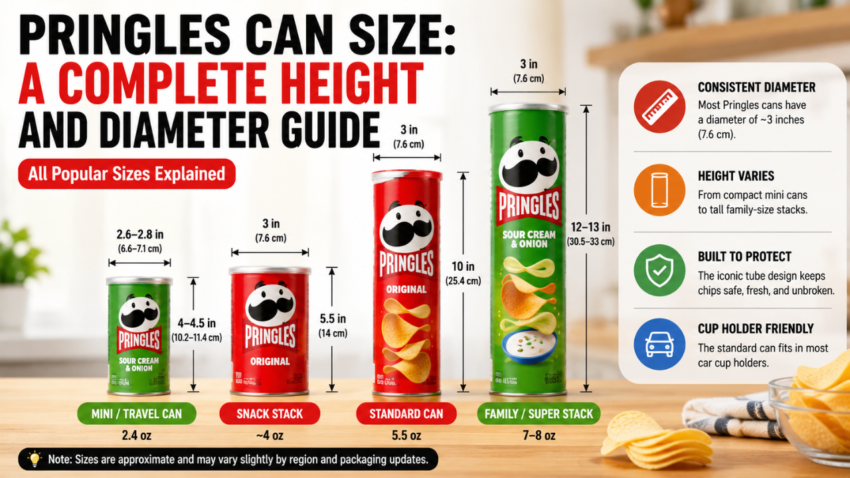
A regular Pringles can. This is the 5.5 oz size you are likely used to seeing at grocery stores, and it happens to be around 10 inches tall by about 3 in diameter before opening. In metric numbers, that translates to about 10 inches high and roughly 3 inches in diameter. This is the version that comes to mind for nearly everyone concerning Pringles, and it’s the size at which every other can in the range is judged against as an exact baseline.
Pringles Can Size by Variant
In its product line, Pringles has different sizes of cans to target a slightly different snacking occasion.
| Pringles Can Variant | Approximate Weight | Approximate Height | Approximate Diameter |
| Mini / Travel Can | 2.4 oz | 4 to 4.5 in (10.2-11.4 cm) | 2.6 to 2.8 in (6.6-7.1 cm) |
| Standard Can | 5.5 oz | 10 in (25.4 cm) | 3 in (7.6 cm) |
| Snack Stack | 4 oz | 5.5 in (14 cm) | 3 in (7.6 cm) |
| Family / Super Stack | 7 to 8 oz | 12 to 13 in (30.5-33 cm) | 3 in (7.6 cm) |
Note that one consistent aspect here seems to be the diameter tending to remain near 3 inches across nearly all versions, while height is what varies most by can size. This is intentional versus accidental design, and one of the reasons this brand’s silhouette remains pretty darn consistent across its entire product landscape.
Why Pringles Cans Are Shaped As They Are
The tall skinny cylinder isn’t merely a branding choice; it’s a practical one. The design of the can was originally intended to fix a problem with potato chip packaging that had been around for decades: chips break too easily during transport and handling. Traditional bagged chips appear in more random, stacked shapes that either break down under their own weight or jockey for space as they travel. The chips are stamped into a curved saddle shape, and then stacked evenly one on top of the other inside a rigid tube, allowing for efficient nesting with considerably less breakage than in an ordinary bag.
Additionally, the hard cardboard structure combined with a metal base and plastic lid protects its contents better from indentation, moisture, and becoming stale than a flexible bag could. That general tall, skinny container is part of the overall fix to these packing issues and has remained popular for decades since it appeared so effective straight from the beginning.
Pringles Can Size as compared to other packaging types.
This offers a better perspective of the shape than seeing it next to something like canned goods, he said.
| Item | Approximate Height | Approximate Diameter |
| Standard Pringles Can | 10 in | 3 in |
| Standard 12 oz Soda Can | 4.8 in | 2.6 in |
| Standard Coffee Canister | 6 to 7 in | 4 to 5 in |
| Tennis Ball Tube (3 balls) | 8 in | 2.75 in |
A normal Pringles can is significantly taller than a soda can (about twice as high) while retaining roughly the same width, which is one of the reasons that both types of containers commonly pop up when internet users use each other for comparisons. It is also relatively similar in dimensions to a canister of tennis balls, another tall narrow cylinder designed for shipping and storage.
Also Read: Celsius Can Dimensions | Standard Magazine Size | Full Bed Dimensions in Feet
Comparing Pringles Can Size to Everyday Objects
Keen to these measurements, we sometimes find that numbers on a label won’t actually translate into a mental image for us, so it can help to match some of them up against a few items we’re familiar with. That was the rough height of a regular pencil, and also about one standard can of Pringles (which stands roughly 10 inches tall to match in height with a standard ruler laid on one end) or just under the long side of an 8.5-by-11-inch sheet of letter paper (the long edge being 11 inches).
In diameter, the approximately 3-inch width is around the same as a household baseball, or slightly wider than a golf ball laid two to three high, so this gives a relatively easy understanding of how the can feels when it is cupped in one hand.
Will Pringles Can Fit in a Cup Holder
For the most part, yes, and this is one of the more bitched about observations on the brand’s packaging. At just under 3 inches, the standard can fits mostly comfortably in the vast majority of car cup holders; most automotive manufacturers design their cup holders to accommodate somewhat around a 2.5 to 3-inch range as this hits many standard beverage cans and bottles. However, the height of a 10-inch can means it almost always sticks well above the rim of the holder itself, although this rarely interferes with parked stability there.
The mini and Snack Stack sizes are shorter than regular cans, making them popular for car trips, lunch boxes, or the side pocket of a backpack where you might not want an unwieldy full-height standard can.
Pringles Can Size for Storage and Travel
| Use Case | Recommended Can Size | Reason |
| School lunch | Mini Can | Compact and lightweight |
| Office desk | Snack Stack | Easy to store in drawers |
| Road trips | Standard Can | Good balance of size and quantity |
| Family movie night | Family Can | More chips for sharing |
| Pantry storage | Standard or Family | Efficient shelf organization |
A Brief History Behind the Design
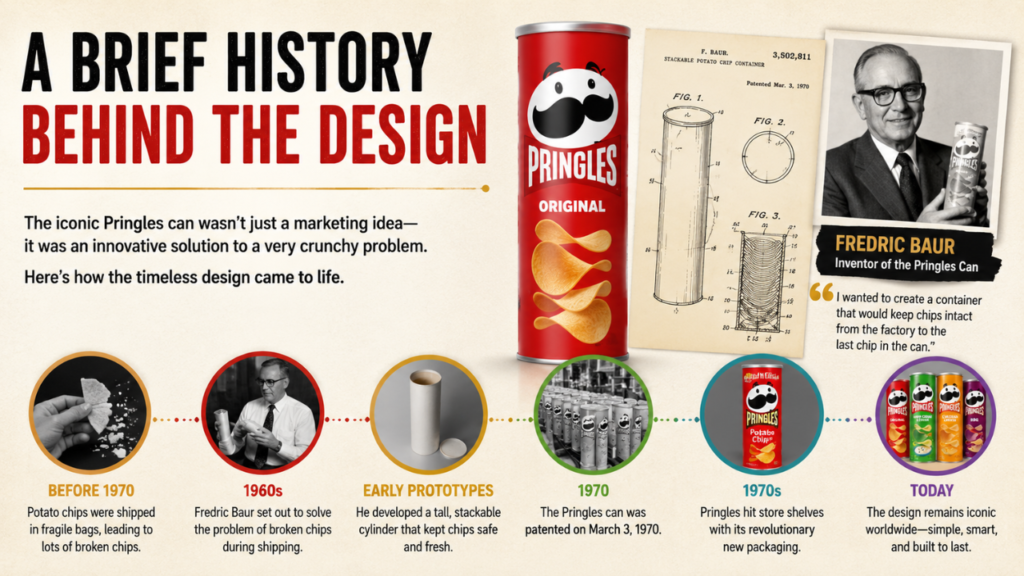
Patented in 1970 by inventor Fredric Baur, the round can we all know and love was designed specifically to solve the perennial shipping issue of potato chips breaking up into dust. Back in those days, traditional bagged chips were said to sustain crushing breakage rates before they made it anywhere near grocery stores, although the rigid canister eliminated most of that by holding each chip securely in its own uniformly aligned position inside the tube. The design was something Baur reportedly identified as one of his career highlights, and the can’s simple construction has been robust enough to see continuous service for more than five decades.
While the branding, flavorings, and label designs for Pringles have changed greatly over the decades since their invention, the basic Pringles can size and shape have barely budged. Although some materials or lid designs have been slightly changed to support recycling and manufacturing, the height vs. diameter ratio that made your standard a standard probably hasn’t changed much from its original specs. That reliability is part of what keeps the can one of the most recognizable pieces of snackware in the world today, easily readable on a shelf or from range and in low light conditions.
Repurposing an Empty Pringles Can
That standard tube shape has proved so durable and reliable that empty Pringles cans are a really sought-after home organization option as well as very simple art projects. The cans’ hard cardboard body and a snug plastic lid make it simple to reuse an empty can for stowing pens, small tools, rolled-up artwork, or kitchen gadgets that would otherwise be littering a drawer. Some use them as mini planters for little houseplants; others slice and color them to make classroom or office supplies boxes.
Knowing a can’s height and diameter beforehand is actually beneficial for these kinds of projects, because it allows you to make sure a can will comfortably fit in a cabinet, on your shelf, or next to your other containers without needing to physically paw and measure an available can. This sort of ancillary use is a small but telling example of how clean packaging design can survive sometimes far beyond the packaging’s original intent to hold snack products.
Why Pringles Can Size Matters Beyond Curiosity
Incorrect Pringles can size isn’t just a piece of trivia. For retailers, it has an impact on shelf planning and the number of units that fit into a certain display area. For consumers, it is whether or not a can will fit snugly on a pantry shelf, in a bag, or even into an available container used for containers repurposed as small items storage. If you want to use an empty Pringles can for storage-say, for pens or tools or rolled-up items- you might also be interested in the dimensions ahead of time, as people have now fully embraced the cylindrical shape and stiff construction of those empty cans for household organization and craft projects.
Also Read: Things That Are 1 Inch | Things That Are 8 Inches Long
Conclusion
The typical Pringles can is about 10 inches tall and three inches wide – it is a defining, mostly constant aspect of its brand, dating to decades ago when the design was originally established. Whether it’s in the compact mini can format or a tall family-size version, the core diameter is about the same across the range, with height varying to fit serving sizes.
From checking to see if a Pringles can will fit in your car’s cup holder, to figuring out how much you need in the pantry, or just sampling some curiosity about the numbers behind this recognizable tube, knowing how different sizes of Pringles cans measure up provides a minor-yet-authentic glimpse into what making smart packaging design elements for posterity might involve.
FAQs About Pringles Can Size
1. How many grams is a normal Pringles can?
A standard can holds 5.5 oz of Pringles chips, about 10 in tall with a diameter of 3 in.
2. How tall is a mini can of Pringles?
4- 4.5 inches in height for mini chips like the mini Pringles cans
3. What size is a family-sized Pringles chip can?
Family size cans are typically 12-13 inches tall and have a diameter of 3 inches.
4. Does it differ based on the can size?
No. Approximately 73 mm (about 3 inches) in diameter for most Pringles cans.
5. When was the Pringles can introduced?
The signature canister design would be patented in 1970.