
A sign announces that a hazard is 50 feet ahead, a real estate listing touts a 50-foot backyard, or a safety guideline tells you to keep at least 50 feet from something, and the number doesn’t really register. Paper distances seldom mean much in terms of visualization. But how far is 50 feet really, in real terms you can actually picture? This guide simplifies it with simple conversions, examples from everyday life, and answers to the most common questions that people ask about this surprisingly encountered distance.
How Far Is 50 Feet? The Basics
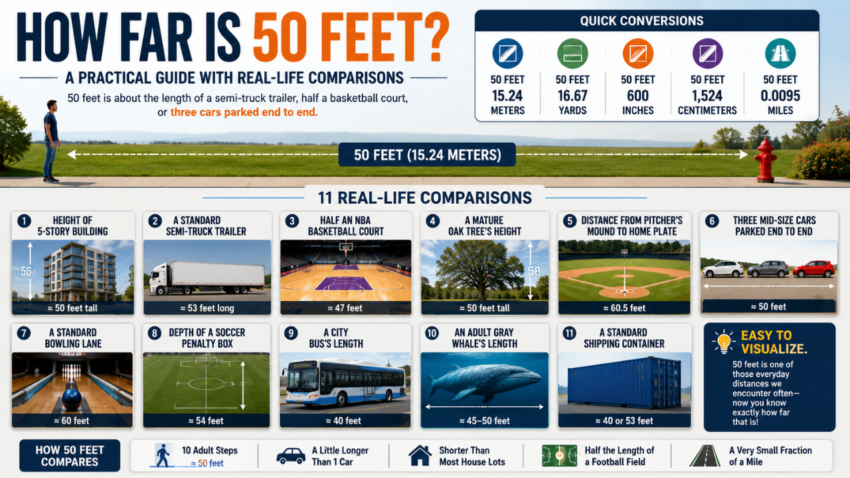
50 feet is not really short; it can cover a good portion of your yard or parking lot, yet it can be covered in less than a minute’s walk. That’s about 50 feet, or in the metric system, roughly 15.24 meters. That translates to just shy of 16.7 yards, although for those of us more familiar with the yard-based measurements common in sports or landscaping, it can come in handy for everything from lawn sales.
Quick Conversion Table
| Measurement | Equivalent |
| 50 feet | 15.24 meters |
| 50 feet | 16.67 yards |
| 50 feet | 600 inches |
| 50 feet | 1,524 centimeters |
| 50 feet | 0.0095 miles |
That last conversion is a nice reminder that as small as 50 feet appears up close, it’s fractions of a mile and puts that in relation to longer distances found on your daily walking commute or running route.
50 feet? 11 Common Distances that Give You a Sense of How Long That Is
Whether we believe the numbers should be tied to something real, numbers rarely stick. Each reference lands somewhere near that number, including both precise measurements and everyday comparisons. This is a small selection of common features.
1. Height of 5-story building
A five-story building comes in at almost exactly that height using the common architectural estimate of about 10 feet per story, giving it one of the simplest answers to how far is 50 feet when imagined vertically. The same distance from ground level, looking up at a mid-rise apartment or office building, offers an authentically applicable vertical sense.
2. A Standard Semi-Truck Trailer
Semi-truck trailers used in long-haul freight typically are about 53 feet long, slightly longer than this distance. It’s a length that anyone who has passed one on the freeway or seen one back into a loading dock has an excellent visual perception.
3. Half an NBA Basketball Court
An NBA court is 94 feet from end to end, meaning its halfway point lies at 47 feet-less than this distance. Basketball fans who have seen someone sprint the floor to half-court already have an approximate mental picture of about this distance.
4. A Mature Oak Tree’s Height
Numerous oak trees grow nearly this lofty for a long time in their lives, especially when they are elders that have not fully matured. If you stand at the bottom of a tall tree in your backyard and look straight up, you can get a pretty good sense of this vertical distance.
5. The Distance To Pitcher’s Mound From The Home Plate
Baseball has the official distance from the pitcher’s mound to home plate: 60.5ft, which is longer than that but close enough to be a ballpark reference point. Anyone who has watched baseball or played it has a general idea how far that throw really travels.
6. Three Mid-Size Cars Park End to End
Three of those parked bumper to bumper land close to the total distance because a typical mid-size car is about 15 feet long. A car lot or driveway, a handy and visual comparison for anyone trying to imagine it.
7. A Standard Bowling Lane
The distance from the foul line to the head pin in a regulation lane is 60 feet, almost exactly that; then again it’s more of a mental anchor for those who have rolled a ball down it and watched it glide along some of that stretch.
8. How Deep is a Soccer Penalty Box?
A standard soccer field has a penalty area that is 18 yards (54 feet) deep, so this falls just outside of that boundary. Pretty much anyone who has witnessed a place kick in soccer knows this roughly-sized visual space.
9. A City Bus’s Length
Standard city buses are usually about 40 feet long, a bit shorter than this distance – but it’s still useful for comparison. Roughly this distance can be envisioned by imagining a bus parked at the curb but allowing for some space in addition.
10. An Adult Gray Whale’s Length
As such, mooring line measurements to buoy devices will remain fairly consistent. For monks in adult gray whale populations, 45 feet long is roughly the length of an average unicorn and, at around 50 feet long, provides perhaps the most natural comparison to this range. That is a comparison that sticks, since outside of an actual whale, very few common comparatives convey scale quite like one.
11. A Standard Shipping Container
Freight transport shipping containers often exist in 40-foot and 53-foot dimensions, bracketting this distance from either end. This gives a rough visual notion of just how large container stacks at ports or rail yards are publicly visible.
The difference between How Far is 50 Feet to nearby distances
This measurement should be put into context, which is better done by placing this figure next to some longer and slightly shorter distances.
| Distance | In Meters | How It Compares |
| 25 feet | 7.62 m | Half this distance |
| 40 feet | 12.19 m | Somewhat shorter |
| 50 feet | 15.24 m | Reference distance |
| 60 feet | 18.29 m | Somewhat longer |
| 100 feet | 30.48 m | Double the distance |
| 150 feet | 45.72 m | Triple the distance |
How Far is 50 Feet (Without a Tape Measure): The Simple Trick
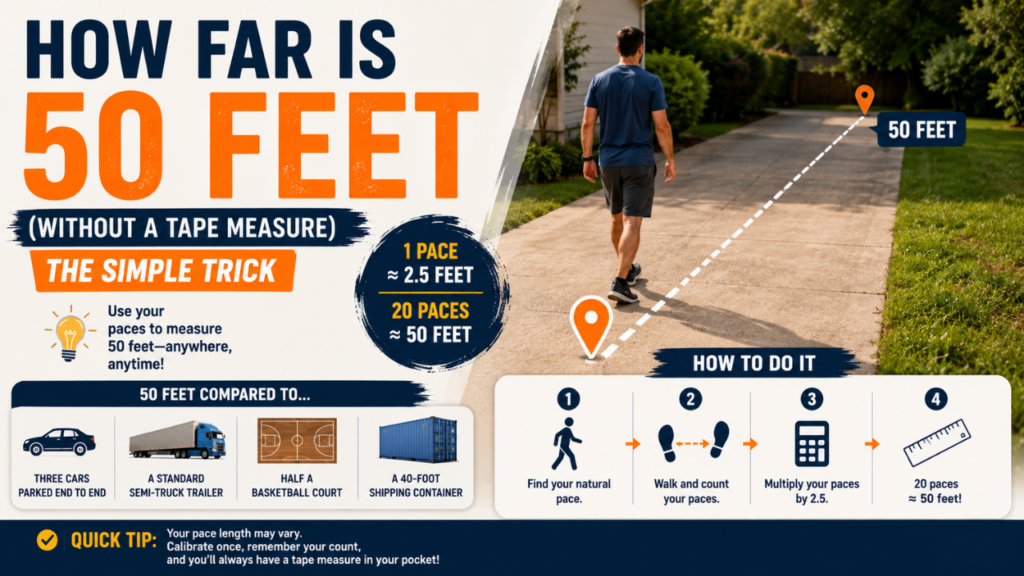
In case you do not have any measuring equipment available, there are a few physical references that can allow the estimation of this distance quite accurately. One of the most practical tactics is counting adult walking paces since the average adult stride length is around 2.5 feet, which means that 20 paces will put you within a couple of dozen feet or so from where you are going, almost close enough to get in trouble.
Another shortcut is picturing a semi-truck trailer parked nearby: that vehicle is so close to this distance (just past the truck length). Or if you don’t want to get out your tape measure for whatever reason, consider the length of three parked cars in a row at the bumper, which gives you an off-the-cuff estimate of how far 50 feet is without having any tools whatsoever.
Why Knowing How Far Is 50 Feet Matters So Often
There is a practical reason that this specific metric comes up so often in context.
You often see backyard, driveway and lot sizes that come close to this number in real estate and property listings, as it represents a usefully modest amount of space outside without needing an unreasonably large property.
This is also the same number of feet used with instructions on how far to stand away from hazards, wildlife, fireworks or equipment in safety guidelines, because it’s just far enough away to do good but still a distance someone can accurately gauge without an instrument.
On the sports and recreation side of things, various fields and courts cluster right around this number, making it a genuinely useful target for fans who already have an inn IIs sense about these spaces from watching or playing.
That’s because this distance is long enough, but short enough that a small survey company can measure it reasonably easily, as well as usefully close to generally practical project sizes.
In transportation, from semi-trucks to shipping containers, lengths and roadway measurements regularly cluster near this number; it’s why so many transport cognates work in illustrating that distance.
How Far Is 50 Feet In Different Daily Scenarios
You will have been presented with lots of the feel distances never really matter until you cross them, so the way this distance feels is entirely contextual, since the same distance across different settings registers completely differently.
Indoors versus outdoors. Fifty feet in a building might feel like quite a distance, often covering multiple rooms or a lengthy corridor; outside, the same distance in an open field or parking lot doesn’t seem as far since there aren’t any features to break up that space.
Walking versus driving. On foot, this distance takes a few seconds to cover at a leisurely speed; in a vehicle it flies past the driver almost immediately, and this is part of why drivers often misjudge following distances, passing distances, or parking spots.
Flat ground versus elevation change. Fifty feet across level ground is so much easier than fifty feet up a steep grade, or fifty stairs: if the aim is to be here, then distance provides the obstacle; if the next destination comes knowing it will require an ascent, our mind begins to stretch that distance further by combining actual length with vertical, and every horizontal foot becomes a fight against gravity.
Familiar versus unfamiliar spaces. Far distances you cross every day, say, a driveway or a short walk to your mailbox, feel much shorter once you’ve logged enough experience doing them regularly – whereas the same distance in an unfamiliar landscape becomes very hard to determine on sight alone.
And it actually is useful to think through some of these situational disparities as a reminder that cold numbers only tell you part of the story, and how far is 50 feet is practically often depends at least as much on the situation as the number.
Also Read: 36 Inches | How Big Is 8 Inches | How Much Is 25kg
Conclusion
However, when you put this distance next to everyday things- a five-story building, the length of a semi-truck trailer, or almost as much as half an Olympic-size basketball court- it stops simply being some number and is so much easier to visualize. How far is 50 feet, you ask, and if you’ve never seen it firsthand, these real-world comparisons will make things much more relatable. 50 feet might not seem terribly far away, but without some actual context and perspective, it can be surprisingly challenging to conceptualize.
It would also be an extremely practical thing to keep in the back of your mind during everyday situations, as this measurement often finds itself in property descriptions, sports, construction, and safety regulations – and being able to think of how far is 50 feet can help you easily navigate these areas.
Frequently Asked Questions (FAQs)
1. How far is 50 feet in yards?
This converts to approximately 16.67 yards and is a great conversion for anyone who is more familiar with the yard-based measurements used in sports or landscaping activities.
2. What is the best way to estimate 50 feet without a tape measure?
That’s approximately 20 average adult walking paces, because a stride is roughly 2.5 feet long, or visualize a semi-truck trailer parked in the vicinity to understand spatial reference points.
3. Why is this 50 foot distance so common in safe practice guidelines?
This exact distance is common to many safety warnings involving wildlife, fireworks, or equipment and has been determined reasonably, purposely, and judgably.
4. How far is 50 feet in meters?
Assuming you are able to convert that fifty feet away to roughly 15.24 meters, as a standard conversion is about 0.3048m per foot.
5. Which sports field or court is close to 50 feet?
A half NBA basketball court is 47 feet long, and the depth of a soccer penalty area measures 54 feet, both coming pretty close to this distance.