
Whether you are plotting out a running route, doing a math assignment, or simply trying to understand the road sign down the street, converting mile to feet is just one of those simple everyday calculations that seems to come up more often than expected. Unlike the metric system, one goes through clean multiples of ten with every conversion in it, but imperial does not – hence why so many people pause and double- check themselves before completing a mile to feet calculation. This guide explains everything from the precise formula to practical examples in real life.
Mile to Feet Converter
Mile to Feet Calculator
Basic Mile to Feet Conversion
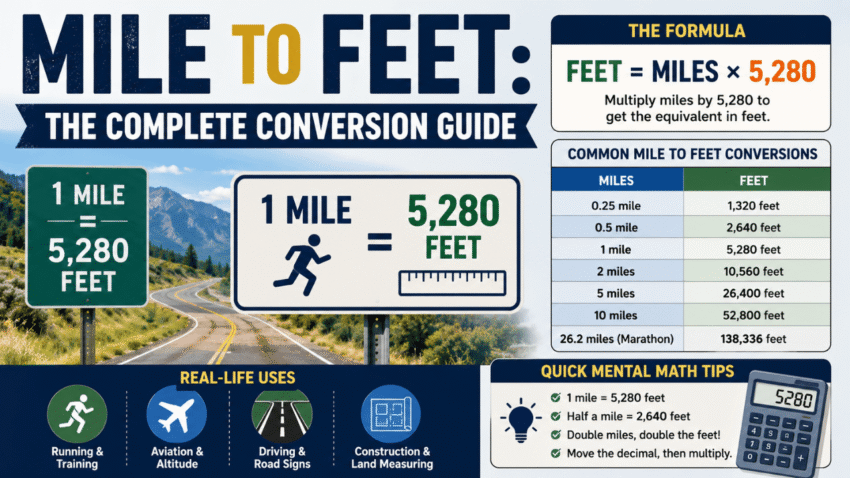
Any conversion from miles to feet begins with a solid number - but in this case, only one of them: one mile equals exactly 5,280 feet. Compared to the metric system that neatly scales by base ten, this number has historical origins going back as far as old English units of measurement - a mile was originally derived from Roman paces but ultimately rounded and standardized into the 5,280-foot number we use today in most of the world, not in imperial measures like the United States and the United Kingdom.
| Unit | Equivalent |
| 1 Mile | 5,280 Feet |
| 1 Mile | 1,760 Yards |
| 1 Mile | 1.609 Kilometers |
The Mile to Feet Formula
Converting mile to feet is just a simple multiple :
Feet = Miles × 5,280
Whatever your miles, multiply that by 5,280 to get the copacetic feet equivalent. The fundamental math of any mile to feet conversion is easy once you've locked in that magic number, and this doesn't change whether you're converting a whole number, turning a fraction into miles or decimal value.
Mile to Feet Conversion Formula
| Conversion Direction | Formula |
| Miles to Feet | Multiply by 5,280 |
| Feet to Miles | Divide by 5,280 |
Common Mile to Feet Conversions
Because common mile to feet conversions reverberate in everyday conversation, running, driving and academia, with a reference table handy it avoids you recalculating the same distances over and over.
| Miles | Feet |
| 0.25 mile | 1,320 feet |
| 0.5 mile | 2,640 feet |
| 1 mile | 5,280 feet |
| 2 miles | 10,560 feet |
| 5 miles | 26,400 feet |
| 10 miles | 52,800 feet |
| 26.2 miles (Marathon) | 138,336 feet |
These benchmark numbers are great to have on hand because they allow you to quickly convert a mile into feet at any time without having to reach for the calculator or manually run through the multiplication process.
Why 5,280 Feet in a Mile?
But that's a perfectly legitimate question: why does a mile-to-feet conversion depend on such an oddly specific number, instead of something more round- 5,000 feet, for instance? The explanation lies in the historical roots of the mile. Mile: (from the Latin mille passus ~ a thousand paces; originated as a Roman marching distance.) After English measurements evolved independently from Roman ones, the mile was settled on as 5,280 feet, a number that hewed closely to an older measurement called a furlong: Specifically, eight furlongs make exactly one mile.
This is precisely the kind of historical quirk that means a mile to feet conversion doesn't behave with neat base-ten efficiency like metric conversions do. This is less than merely a decimal shift - you are using a fixed multiplier that is not as tidy (visually) to work with as multiplying by 1,000, but since it works reliably and predictably once memorized, it can be essentially indistinguishable.
Step-by-Step Example Calculations
For further clarity, here are some worked examples to clarify the mile to feet conversion with different inputs.
Example 1: Convert 3 miles to feet. 3 × 5,280 = 15,840 feet
Example 2: Convert 0.75 miles to feet. 0.75 × 5,280 = 3,960 feet
Example 3: Convert 12.5 miles to feet. 12.5 × 5,280 = 66,000 feet
As these instances prove, each mile to ft conversion relies on multiply the same means no matter which math style you're dealing with - whole numbers, fractions or decimals. If you can only remember the 5,280 number then the calculation itself is really a simple arithmetic.
The Real Life Examples That Will Make You Need this Conversion
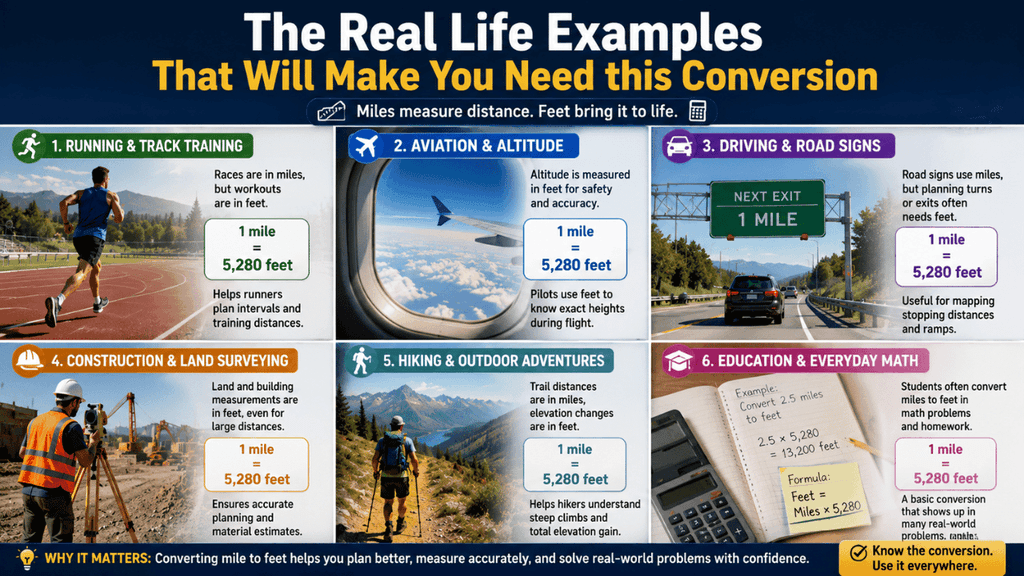
Converting mile to feet is not an academic exercise, it finds its way into our practical everyday lives quite frequently.
Running and track training. Although most longer runs are typically tracked in miles, many track workout and interval training sessions are based on feet or laps around a standard track so mile to feet conversions can be very handy for runners trying to convert between different training plans and races.
Aviation and altitude measurements. This means that pilots and air traffic controllers usually use feet for altitudes but miles or nautical miles to measure horizontal distances, which requires mental conversions in some equations.
Construction and land surveying. A mile to feet conversion is therefore a common component of many surveying and construction calculations, since large-scale land measurements are often defined in miles while more local and precise site work uses feet.
Hiking and outdoor recreation. Trail markers, elevation gain numbers and distance signs occasionally mingle miles with feet on the same hike, making hikers switch mentally on how much ground or vertical remains.
Mile to Feet in Everyday Contexts
| Scenario | Typical Unit Used | Conversion Needed |
| Marathon or Long-Distance Running | Miles | Occasionally converted for pace calculations |
| Track and Field Sprints | Feet or Meters | Rarely requires mile to feet conversion |
| Road Trip Distances | Miles | Occasionally converted for precise local navigation |
| Land Surveying | Both | Frequently requires mile to feet conversion |
| Aviation Altitude vs Distance | Feet and Miles | Regularly requires quick conversion |
A Helpful Mental Math Approach
Mile to feet conversion, because the number 5,280 is not a nice, round decimal-friendly one and instead of them shifting the decimal point it requires real multiplication unlike metric comparisons which will give easily with a shifty mash of the decimals With this in mind, a good rule of thumb is to break the multiplication down into steps. As an illustration, to convert 4 miles to feet, do 4 × 5,000 = 20,000 and then add 4 ×280 = 1,120 or a total of 21,120 ft. It is much easier to mentally convert a mile into feet for both miles as the multiplication is done in two more manageable parts than doing it by multiplying the 5,280 number all at once.
Converting Feet Back to Miles
We might as well cover the opposite as well, because knowing both directions puts the mile to feet relationship into much more clear terms. To go back from feet into miles, all you have to do is divide the number of feet by 5,280 - specifically the inverse calculation of what a typical mile to feet conversion would look like.
So, how many feet are there in 2 miles? Well for starters, there is 5,280 feet in a mile so you can take the math to just divide to figure this out. And because both routes are ultimately based on the same fixed conversion of 5,280 feet per mile, switching back and forth is always just a matter of multiplying or dividing by that number.
Common Mistakes to Avoid
Next, we outline some simple errors that can trip people up when converting mile to feet - even when they have a clear formula. A common error is to remember the conversion factor itself incorrectly, often mistaking it for either 1,760 yards per mile or 3,280 feet in a kilometer, as both these numbers are wholly irrelevant numbers associated with their units. A similar issue is caused by the decimal placement with fractional mile values, since multiplying a number like 0.4 by 5,280 could get you into off-by-a-decimal-place trouble if not done carefully. It's always a good practice to double-check your calculations for larger distances after converting from mile to feet.
Common Conversions From Mile to Feet
It is also handy to know how a mile to feet goes in relation to other common distance conversions, since it can help not jumble up the individual conversion numbers - always good for avoiding losing track of the various factors within each conversion.
| Conversion | Factor |
| Miles to Feet | × 5,280 |
| Miles to Yards | × 1,760 |
| Yards to Feet | × 3 |
| Feet to Inches | × 12 |
If you look at this side-by-side it really helps underscore why the mile to feet conversion factor is specifically 5,280 because ultimately it's just a calculation of 1,760 yards per mile times 3 feet per yard, which becomes a lot clearer when you see the full chain of imperial unit conversions next to each other.
Also Read: KM to Meters | How Tall Is 100 Feet | How Tall Is 40 Feet | How Far Is 50 Feet
Conclusion
The conversion of mile to feet boils down to this one single number: 5,280. If you're needing to calculate running miles, complete a surveying project or are simply curious about mile to feet calculations (or any length conversions for that matter), remembering that there is always exactly 5,280 feet in one mile - and knowing that all you need to do for the entire conversion process is multiply or divide by this figure every time - makes fortune over any mile equals foot calculation straightforward and precise.
Frequently Asked Questions
1. How many feet are in a mile?
There are exactly 5,280 feet in one mile.
2. How do you convert miles to feet?
Feet = Miles × 5,280.
3. Why is a mile-to-feet conversion not a round number?
The mile comes from older non-decimal measurement systems, unlike the metric system.
4. How many feet are there in half a mile?
1 mile = 5280 ft, so half of a mile is: (0.5)*(5280)=2640 ft.
5. Is a marathon miles to feet conversion?
Sometimes. A marathon is 26.2 miles, or 138,336 feet