
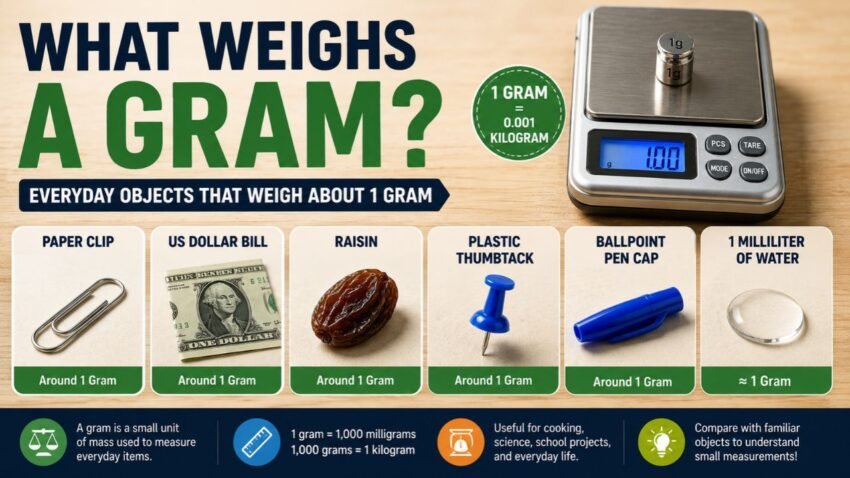
Have you ever wondered what weighs a gram and how light that amount really is? A gram is a small unit of mass used to measure everyday objects, food ingredients, and other lightweight items. Several familiar things weigh approximately one gram, including a standard metal paper clip, a US dollar bill, a raisin, a plastic thumbtack, and a ballpoint pen cap. One milliliter of pure water at around room temperature also has a mass close to one gram, making it a useful reference for understanding this measurement. Knowing what weighs a gram can help with cooking, school projects, science experiments, crafts, and estimating the weight of small objects when a scale is unavailable.
Although these examples are useful, their actual weights can vary depending on their size, material, and design. A gram is equal to one-thousandth of a kilogram, so it takes 1,000 grams to make one kilogram. Understanding this simple measurement becomes easier when you compare it with objects you already use every day.
What Weighs a Gram? Understanding the Basic Measurement
The question “what weighs a gram” is easier to answer when you understand what a gram represents. A gram, abbreviated as “g,” is a metric unit of mass commonly used to measure small quantities of food, stationery, and other everyday items. It is light enough that many objects weighing one gram can be held between your fingers without noticing much weight.
For a practical comparison, consider a small paper clip or a single raisin. Both can weigh around one gram, although the exact weight depends on the product. These examples are helpful for developing a sense of measurement, especially for children learning about mass or anyone who needs a quick reference for a school activity.
How Much Is One Gram?
One gram is a very small amount of mass compared with common household measurements. It equals 1,000 milligrams and 0.001 kilograms. In the metric system, grams are frequently used for lightweight items, while kilograms are more convenient for heavier objects such as bags of rice, luggage, and people. The following table provides a simple comparison of common metric units.
| Measurement | Equivalent |
| 1 gram | 1,000 milligrams |
| 1 gram | 0.001 kilograms |
| 100 grams | 0.1 kilograms |
| 500 grams | 0.5 kilograms |
| 1,000 grams | 1 kilogram |
These conversions are useful when measuring ingredients, reading product labels, or completing science assignments. Once you understand the relationship between grams and kilograms, it becomes easier to estimate the mass of different objects.
Everyday Objects That Weigh About 1 Gram
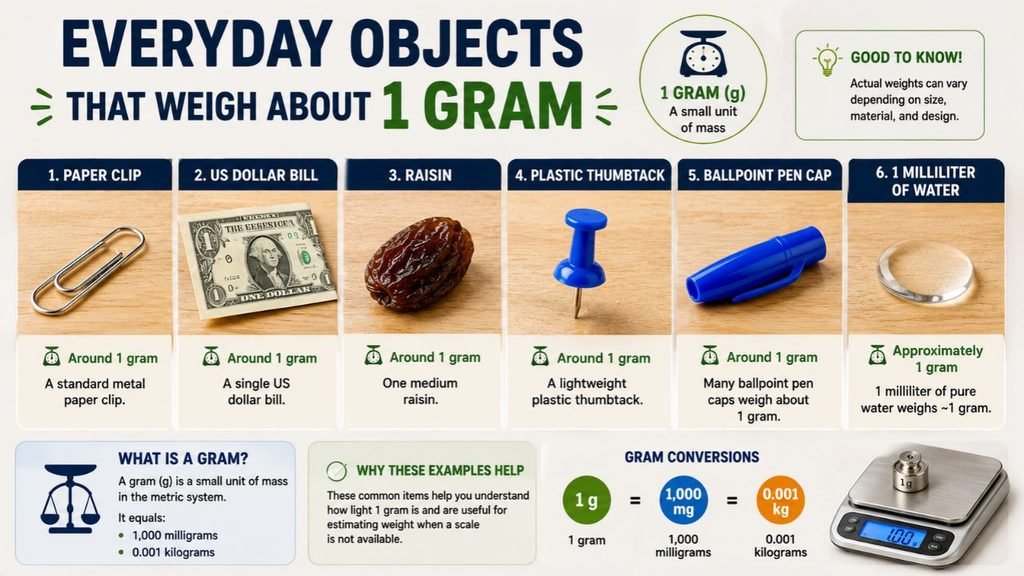
Many familiar objects provide a useful answer to the question of what weighs a gram. A standard metal paper clip, a US dollar bill, a raisin, a lightweight plastic thumbtack, and some ballpoint pen caps may weigh approximately one gram. These objects are convenient examples because they are commonly found at home, in schools, or in offices.
However, it is important to remember that one gram is an approximation for most of these objects rather than a guaranteed weight. Paper clips come in different sizes, raisins vary in moisture and size, and pen caps can be made from different types of plastic. A digital scale is the best way to confirm the actual mass of an individual item.
Examples of Items That Weigh Around One Gram
The table below lists common objects that can help you visualize this small measurement.
| Everyday object | Approximate weight |
| Standard metal paper clip | Around 1 gram |
| US dollar bill | Around 1 gram |
| One medium raisin | Around 1 gram |
| Lightweight plastic thumbtack | Around 1 gram |
| Ballpoint pen cap | Around 1 gram, depending on design |
| 1 milliliter of pure water | Approximately 1 gram |
These comparisons are especially useful when a weighing scale is not available. You can use them as starting points when estimating the mass of other small items, but avoid assuming that every object of the same type weighs exactly one gram.
Also Read: What Weighs 30kg | What Weighs 20kg | Things That Weigh 3 Pounds
What Weighs a Gram in the Kitchen?
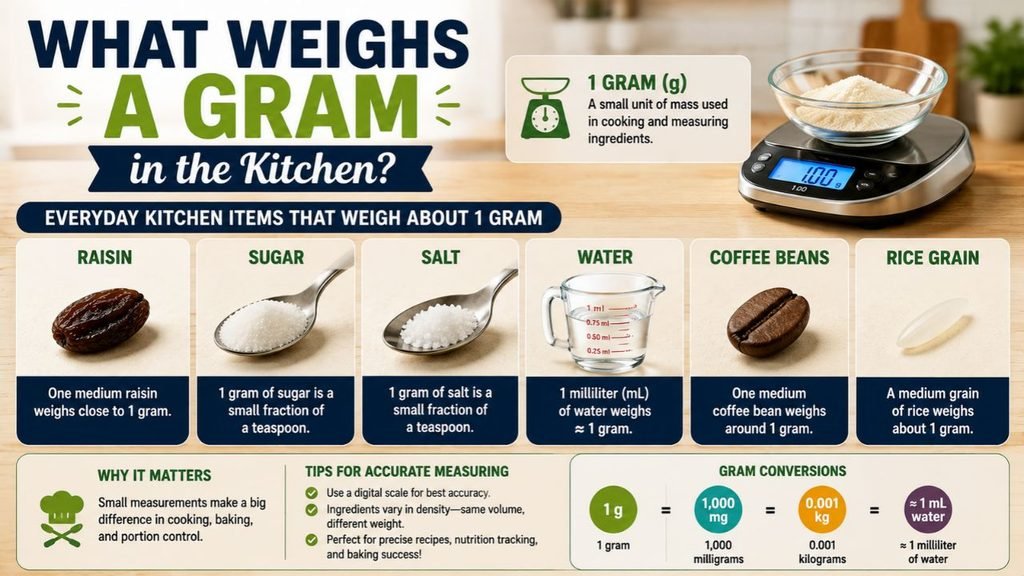
The kitchen is another useful place to explore what weighs a gram. Small food items and ingredients can provide practical examples of lightweight measurements. A single raisin may weigh close to one gram, while a tiny quantity of sugar or salt can be measured in grams when preparing recipes or learning about food portions.
Accurate measurements matter when baking, following recipes, or preparing ingredients that require precise quantities. A teaspoon measures volume rather than mass, so its weight depends on the ingredient being measured. For this reason, a gram of sugar does not occupy the same volume as a gram of flour or water.
Food Items and Ingredients Around One Gram
Different foods have different densities, shapes, and moisture levels. The table below offers general comparisons for kitchen use.
| Food or ingredient | Approximate comparison |
| One medium raisin | Often close to 1 gram |
| Granulated sugar | 1 gram is a small fraction of a teaspoon |
| Table salt | 1 gram is a small fraction of a teaspoon |
| Pure water | 1 milliliter weighs approximately 1 gram |
| A small piece of dried fruit | May weigh around 1 gram, depending on size |
A quarter teaspoon of granulated sugar can weigh around one gram, depending on the grain size and how the spoon is filled. It should not be treated as an exact conversion in every situation. For recipes that require precision, measuring the ingredient on a digital kitchen scale is more reliable than using an approximate spoon measurement.
What Weighs a Gram in an Office or School?
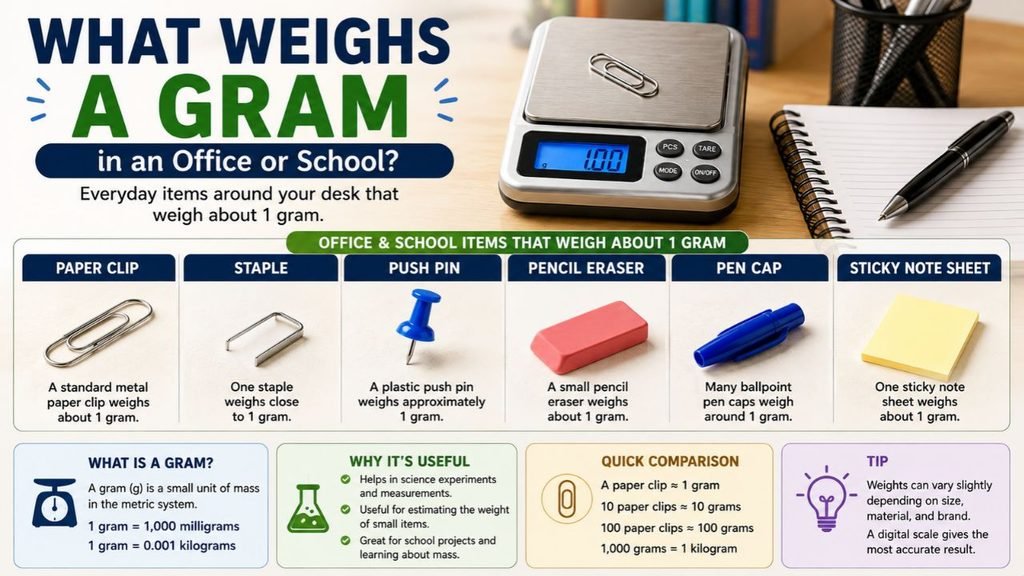
Office and school supplies are convenient for understanding small units of mass because many of these items are lightweight and easy to handle. A metal paper clip, a plastic thumbtack, or a lightweight pen cap may weigh close to one gram. These examples are useful for classroom demonstrations, science activities, and basic measurement lessons.
Students can compare the weights of different supplies and record their results to understand how materials and shapes affect mass. For example, a larger paper clip may weigh more than a smaller one, even though both serve the same purpose. Using a digital scale can turn this simple comparison into a practical science experiment.
Stationery Items and Their Approximate Weights
The following table gives general examples of lightweight stationery items. Actual weights can vary significantly by brand and design.
| Stationery item | Weight estimate |
| Small metal paper clip | Around 1 gram |
| Lightweight plastic pen cap | May be around 1 gram |
| Small plastic thumbtack | May be around 1 gram |
| Standard pencil | Usually several grams |
| Small eraser | Usually several grams |
Not every item in a pencil case weighs one gram. Pencils and erasers generally weigh more, while small plastic components may be closer to this amount. Comparing these objects helps students develop a better understanding of measurement without relying entirely on memorized numbers.
What Weighs a Gram in Science Experiments?
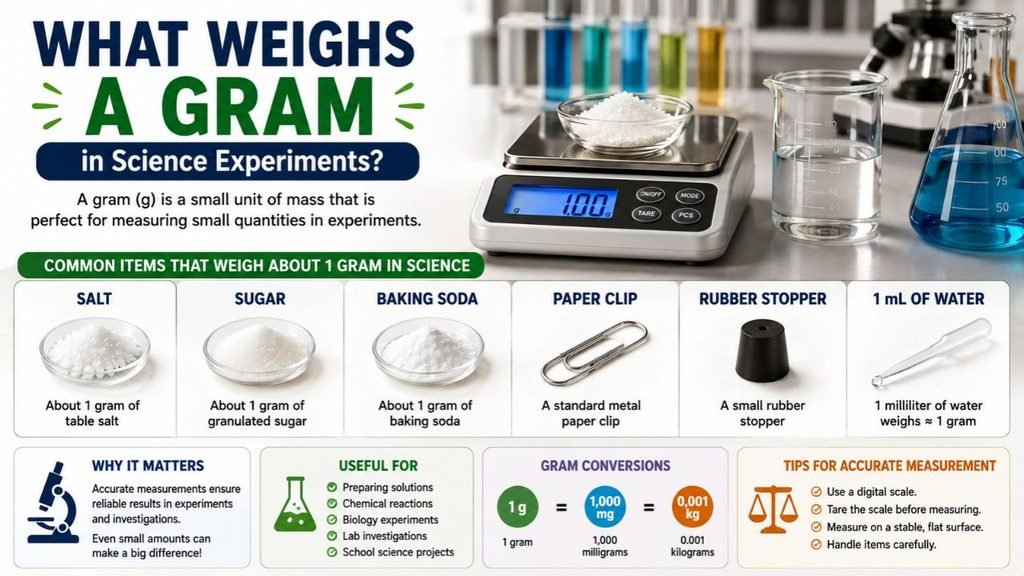
In science, knowing what weighs a gram is useful when measuring small samples, comparing materials, or demonstrating the relationship between mass and volume. One of the most helpful examples is water. At around room temperature, one milliliter of pure water has a mass close to one gram, which makes it an easy reference for introductory science lessons.
This relationship is approximate because water density changes slightly with temperature. For everyday classroom activities, however, one milliliter of water is a convenient way to demonstrate one gram. Students can use a graduated cylinder or measuring syringe to measure the volume and then weigh the water using a suitable scale.
Water and the Gram Measurement
Water provides a practical example because its volume can be measured using common laboratory equipment. One milliliter is equivalent to one cubic centimeter, and both represent the same volume. Under ordinary conditions, this volume of pure water has a mass of approximately one gram.
| Water volume | Approximate mass of pure water |
| 1 milliliter | 1 gram |
| 5 milliliters | 5 grams |
| 10 milliliters | 10 grams |
| 50 milliliters | 50 grams |
| 100 milliliters | 100 grams |
These comparisons assume pure water and exclude the weight of the measuring container. If you place water in a cup on a scale, remember to tare the scale or subtract the container’s weight to obtain the mass of the water alone.
How Can You Estimate One Gram Without a Scale?
Estimating one gram without a scale is possible by comparing an unfamiliar object with something whose mass is reasonably well known. A US dollar bill, a standard paper clip, or one milliliter of water can serve as a reference. These comparisons are useful for everyday learning, but they should not replace precise measurement when accuracy is important.
You can also make a simple home experiment by collecting several lightweight objects and weighing them together on a digital scale. If the scale measures only whole grams, weighing multiple identical items can improve your estimate of the average weight of one item. Divide the total mass by the number of objects to calculate an approximate mass per item.
Tips for Estimating Small Weights
When estimating the mass of an object, consider its material, size, and thickness. Two objects that look similar may have different weights because one is made from metal and the other from plastic. Food items also vary in size and moisture, so a single raisin may not weigh the same as another.
For the most reliable result, use a digital scale designed to measure small quantities. Place the object on the scale, ensure that the reading has stabilized, and check that the scale is set to grams. If you are measuring very lightweight objects, use a scale with a suitable resolution, such as 0.1 gram or 0.01 gram, depending on the level of precision required.
Also Read: How Much Is 25kg | How Much Is 10 Kg | What Weighs 10 Pounds
Conclusion
Understanding what weighs a gram becomes much easier when you compare the measurement with everyday objects. A standard metal paper clip, a US dollar bill, a medium raisin, a lightweight plastic thumbtack, and some pen caps can all serve as approximate examples. One milliliter of pure water is another useful reference because its mass is close to one gram at room temperature.
These comparisons can help with school projects, kitchen measurements, science experiments, and everyday estimates. However, the exact weight of an object depends on its size and material, so familiar examples should be treated as guides rather than precise standards. When accuracy matters, use a suitable digital scale to measure the object directly.
FAQs About What Weighs a Gram
1. What common household item weighs one gram?
A standard metal paper clip or a US dollar bill is often used as an example of an item weighing approximately one gram. However, the exact weight varies by size, material, and manufacturing specifications.
2. Does one milliliter of water weigh one gram?
One milliliter of pure water has a mass close to one gram under ordinary room-temperature conditions. Its exact mass varies slightly with temperature because water density changes.
3. How many milligrams are in one gram?
There are 1,000 milligrams in one gram. This conversion is useful when measuring small quantities of ingredients, laboratory samples, or other lightweight materials.
4. Does a raisin weigh one gram?
A medium-sized raisin may weigh around one gram, but its mass depends on its size, variety, and moisture content. Some raisins will weigh less, while larger ones may weigh more.
5. Can I measure one gram without a digital scale?
You can estimate one gram using familiar objects such as a paper clip or a dollar bill, but these comparisons are not exact. A digital scale is the best option when accurate measurements are necessary.