
The numbers alone mean nothing, no air. You look at a label, scale, or airline baggage policy and see ’10 kilograms’, but in your hands you have only an abstract, vague knowledge of what that actually means. Is it heavy? Is it manageable? Will you carry it all the way up a flight of stairs, or will you need to take a break halfway?
The question how much is 10 kg arises in many more situations than most people would think – packing for a flight, following a recipe, monitoring an exercise goal, selecting a gym weight, needing to purchase pet food, or shipping a parcel. It means, in some sense, knowing the numbers (the conversions to pounds and stone, grams and ounces) but also the more experiential feel (the things you have actually held that weigh this much). This guide covers everything.
Core Conversion: 10 kg in Other Units
The numbers before the real-world comparisons. The kilogram (kg) is the SI base unit of mass, used by most countries for science, trade and everyday life. Ten kilograms is exactly ten times that base unit – a relatively round, clean number which means something across each other metric system.
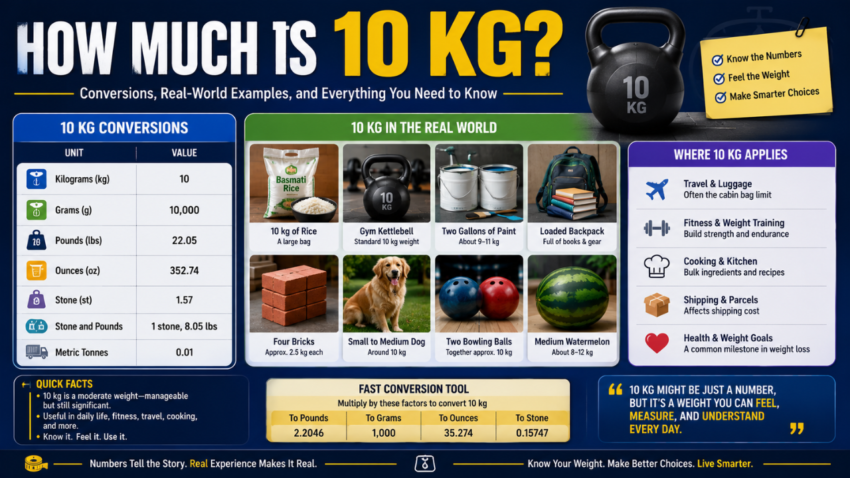
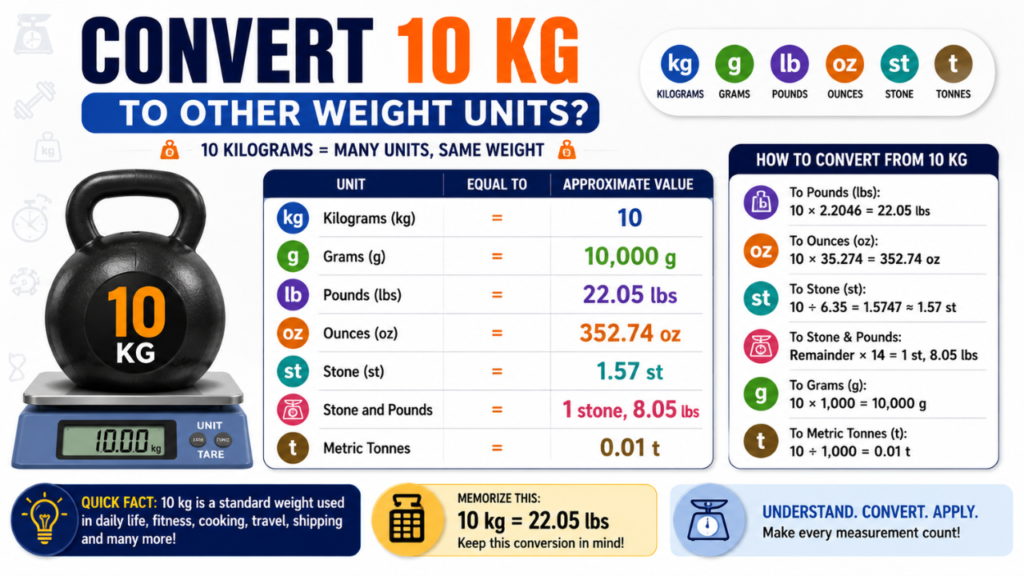
10 kilograms is equal to 10,000 grams, 22.05 lb or 1.57 st. It is a moderate load – significant, but tolerable for most healthy adults.
The entire conversion table is as follows:
| Unit | Value |
| Kilograms (kg) | 10 |
| Grams (g) | 10,000 |
| Pounds (lbs) | 22.05 |
| Ounces (oz) | 352.74 |
| Stone (st) | 1.57 |
| Stone and Pounds | 1 stone, 8.05 lbs |
| Metric Tonnes | 0.01 |
Kilograms to Pounds
Kilograms to pounds is the conversion that most people turn to straight away, particularly in countries like America where everyday life is dominated by the imperial system. Fitness paraphernalia, grocery labels, and shipping paperwork often show the pounds’ value upfront as well, but when users search for how much what weighs 10 lbs is, things like: The conversion factor is 2.2046; thus 10 kg times 2.2046 = 23 lb (approx from math calculations), which comes out to be around 22 pounds as a round number for regular usage.
Kilograms to Stone
The stone is a customary powerful device inside the British and Irish vernacular, particularly when providing an account of body weight. Specifically, 10 kilograms equals around 1.57 stone, which makes it an interesting benchmark for health and fitness or interior design as well. In other words, 10 kg is 1 stone and 8.05 lbs (which has been confirmed against standards from NIST and BIPM). If you want to do this yourself, take the kilogram figure and divide by 6.35 in order to obtain the decimal stone equivalent; then convert back on the fractional part into pounds by multiplying by 14.
Also Read: How Much Is 25kg? A Complete Guide With Real-Life Comparisons
Kilograms to Grams and Ounces
10 kilograms is equal to 10,000 grams because one kilogram has 1,000 grams. This unit benefits scientists, chefs, and laboratory workers alike because it provides an accurate means of mass comparison for small amounts. The ounce conversion and 10 kg is about 352.74 ounces may seem lesser in typical conversation, but they find their use for specialized cooking, postal services, and commercial packaging.
How Much is 10 Kg Based on Real-Life Examples
Data is required, but not by FESW now. Ultimately, how much is 10 kg is depends most adequately on reference to objects you have held or carried yourself. These are the most dependable real-life anchors across varied domains of our lives.
A Large Bag of Rice
One ten-kilogram bag of rice has a total weight of exactly 22.05 pounds. This is the same size sold at US Costco, Walmart, and Sam’s Club stores. 10 kg bags of rice are one of the most well-known household weights found in Indian or South Asian houses across the world, and so one of our more universal 10 kg reference points. Taking one off a bottom shelf, holding it by the body, and pulling it up is one of the most real-world physical representations of how much is 10 kg in action.
Standard Old Gym Dumbbell or Kettlebell
In the gym, a standard weight for strength training is around 10 kg (3.6kg). If you have previously lifted heavy weights, this should give you a sense of the weight. The 10 kg kettlebell is an entry-level standard for kettlebell training too heavy enough to provide real resistance for swings and goblet squats, light enough that almost all adults can train with it without injury. Yep, 10 kilograms = 22.05 pounds exactly, roughly the weight of one third-standard-10-kg kettlebell or a small carry-on suitcase.
Two Full Gallons of Paint
On average, a gallon of either latex or oil-based paint weighs around 10–12 lbs (4.5-5.4 kg). Two gallons, in total, fit exactly into 9–11 kg, making it right at 10 kg. If you have ever hefted two filled paint cans up a ladder, or across a room, then you know precisely how much is 10 kg in each hand, the very definition of density and awkwardness that forces both arms into action.
A Loaded Laptop Backpack
A satchel filled with textbooks, notebooks and supplies could quickly weigh 10 kg. Bags, by the way, were heavy – No wonder students often complain! The 10 kg of the loaded student backpack is probably one of our most ubiquuites experiences, it’s that slow accumulation over a school morning as books and lunch boxes stack up until they’re all resting on young shoulders the whole day long.
Four Standard House Bricks
10kg is 4 bricks, and each single brick weighs approximately 2.5 kg. An awesome resource for those who have any sort of experience in construction or home remodeling work. It is easy to imagine that four bricks piled up in your arms offer a world of difference when it comes to carry around versus a bag of rice or tin of paint, denser, less oddly shaped, and forward leaning. Same mass, completely different feel.
A Small to Medium-Sized Dog
The sweetest part is that many well-loved breeds hover near the 10 kg mark. For example, an adult Cocker Spaniel, Shih Tzu, Beagle or miniature Schnauzer generally weighs from 8 to 12 kg. For dog owners, lifting their animal is one of the most familiar and oft-repeated experiences involving handling something that weighs about 10 kg, and because it includes warmth, motion plus uneven weight distribution, this forms an everlasting physical point of reference to which other activities can be compared.
Two Standard Bowling Balls
This makes two regular bowling balls together one of the most fun ways to visualise this measurement: they weigh precisely 10 kg.) One bowling ball weighs around 4.5-5 kg, in accordance with the selected size. This reference is effective for those with some bowling under their belt, and who have that instinctive feel of how a ball is in the hand
A Medium-Sized Watermelon
An entire, round watermelon of the middle of the size scale commonly weighs 8-12 kg. When all 10 kg are in place, it is that specific type of heavy, round, smooth, no-handle, that reminds you to be grateful for the presence of both your hands. Watermelons from the supermarket chain are one of the most universal 10 kg reference points in the world, even under different climates: you’ll find the same watermelon whether you’re shopping in Mumbai or Melbourne (or Manchester).
Convert 10 Kg To Other Weight Units?
In Fitness and Weight Training
Lifting 10 kg regularly builds true functional strength and grip, plus density in bones. Improper technique – bending at the waist, twisting, one-shoulder carrying leading to lower back strain and shoulder injury. From a fitness perspective, 10 kg is the middle ground between beginner and intermediate – too heavy not to cause muscle adaptation but light enough that most people can safely start with it. 10 kg dumbbells are a significant step up from entry-level lighter weights for movement types such as bicep curls, lateral raises and lunges.
In Travel and Luggage
Ten kilograms is a figure every frequent traveller is well acquainted with. This is the same weight limitation for cabin bags you get on many budget airlines (like Ryanair, IndiGo and AirAsia), which is set exactly at 10 kg. Knowing how many garments that really means, in other words, a week of clothes intended for a hot place, or three days of mixed-climate space, is a very handy travel ability indeed. 10 kg is roughly the weight of a standard 10 kg kettlebell or your average small carry-on suitcase, so confirming the luggage-weight mental model most travellers have.
In Cooking and the Kitchen
In a metric country, for the most part, cooking is done in grams and kilograms. It is no longer about recipe quantities, but rather bulk, as in 10 kg: a sack of flour for restaurant and bakery, quintals of potatoes or onions from a wholesale supplier, a crate box of single variety type, e.g. tomatoes. The equivalent meant for home chefs is the experience of determining how many portions a bulk purchase will provide based on standard recipe yields, such as 10,000 grams.
In Shipping and Parcels
Courier services generally follow a cost bracket that changes significantly around the 10 kg number. Parcels scaling above 10 kg often fall into a heavy freight class – incurring different rates and in some cases an alternative handling approach. It is useful knowledge immediately when you receive quotes from different shipping companies that use different unit systems, but relatively many to recognize (10 kg = 22.05 lbs).
In Health and Weight Loss
10 kgs is 1.57 stone, or roughly, 1 stone is 8 lbs. In the matter of goals, adjusting your weight to losing or gain weight, there is 10 kg, a number that appears worldwide as the target milestone. This is a clinically relevant consideration for health professionals and patients talking about weight management, since the speed at which this can be converted into what the patient thinks in kg, stone or lbs. Losing 10 kg is a fitness goal shared by many, and picturing the result as a huge bag of rice or big dumbbells makes that achievement tangible instead of abstract.
Is 10 Kg Heavy or Not?
If they are lifted cleanly, then yes but as with most things in life the short answer is: it depends on context and by who.
Lots of people wonder how much is 10 kg ? And the answer will depend on your strength and acquired experience. For an athlete who is trained or if you pick up packages and groceries regularly, 10 kg is an ideal working weight; it should be a weight that one can carry in one hand for distance without much effort. 10 kg is a meaningful weight for a child, the elderly, or returning from injury.
National Institute for Occupational Safety and Health (NIOSH) advises the use of proper posture/form with the 10 kg lifts and how often they can be repeated, especially for workers in Retail, Warehousing, construction, and Child care. Knowing this weight furthers the protection of your body in the long-run.
The key variables are:
- Distance: The average supermarket shopping bag, weighing over 10 kg, from the car to your kitchen is no trouble for you. It really is tiring to carry it for a kilometre.
- Form and Grip: Same weight bag with handles is fucking way to easy versus a box without grip.
- Repetition: Lifting 10 kg once means nothing. While performing this 200 times a shift over an eight-hour day is considerable in the occupational sense.
- Lift height: The differences between carrying at waist level and overhead or from the floor are substantial.
Fast Conversion Tools: Calculating it Yourself
These multiplication factors are the easiest way to quickly convert how much is 10 kg in another unit.
| To Convert 10 kg to: | Multiply by: | Answer |
| Pounds (lbs) | 2.2046 | 22.05 lbs |
| Ounces (oz) | 35.274 | 352.74 oz |
| Grams (g) | 1,000 | 10,000 g |
| Stone (st, decimal) | 0.15747 | 1.57 st |
| Stone and pounds | Divide by 6.35, then × 14 for remainder | 1 st, 8.05 lbs |
| Milligrams (mg) | 1,000,000 | 10,000,000 mg |
Also Read: How Far Is 50 Feet? A Practical Guide With Real-Life Comparisons
Conclusion
This deceptively simple question How much is 10 kg reveals to be, in fact, genuinely rich. Notice, it doesn’t require an awards ceremony; in plain numbers: it’s 22.05 pounds, 1.57 stone, 10,000 grams or 352.74 ounces! In practical terms, it’s a Costco-size bag of rice, an average home kettlebell from the gym, two gallons of paint full to the brim, or even a school backpack full of books plus all your gear loaded up and ready for takeoff in that airport carry-on allowance on budget airlines anywhere. In health situations, it is 1 stone and eight pounds, a milestone in weight reduction or gain that docs and patients talk about at regular intervals around the globe.
Grasping how much is 10 kg in both its numerical and physical dimensions makes you better prepared in a surprisingly large number of everyday situations: packing smarter, lifting safer, shipping more accurately, cooking mashed potatoes or rice – for prepping days with more confidence, tracking fitness goals with something that has substance beyond just the number on a scale. When you have the real-world anchors cemented in your brain, like that 10kg bag of rice or a dumbbell from the gym, for example- 10 kg goes from being an abstract metric to something tangible, and you can feel it immediately.
FAQs About How Much Is 10 Kg
Q1. How much is 10 kg in pounds?
10 kg = 22.05 pounds (lbs).
Q2. How much is 10 kg in stone?
10 kg = 1.57 stone (approx. 1 stone 8 lbs).
Q3. How much is 10 kg in grams?
10 kg = 10,000 grams.
Q4. How much is 10 kg in ounces?
10 kg = 352.74 ounces.
Q5. Is 10 kg considered heavy?
It’s a weight that should be light enough to lift comfortably by most healthy adults.