
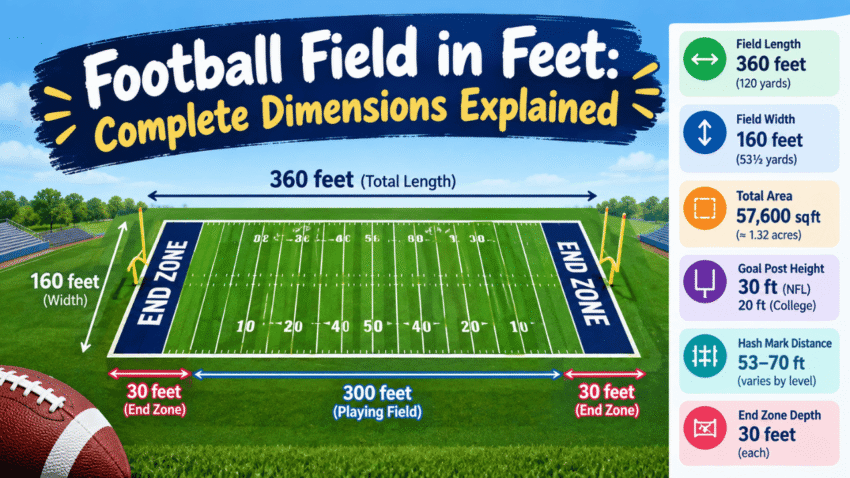
Most everyone knows that a football field is measured in yards, but when you actually need to convert the numbers into feet, be it for a school project or construction comparison, even (as we might imagine) simple curiosity can lead increasingly close to confounding by degrees. This guide goes over the entire football field in feet, including total length & width, end zones, hash marks, and goal post size so you know exactly how big the football field really is.
Total Length of a Football Field in Feet
People ask about a football field in feet, and they usually think of the well-known “100-yard field,” but that number only represents the actual playing area between the goal lines. Actually, the full football field in feet – with both end zones- measures much longer.
Here’s how it breaks down:
- Playing field (goal line to goal line): 100 yards, which equals 300 feet
- Each end zone: 10 yards deep, which equals 30 feet
- Two end zones combined: 60 feet total
When you combine the playing field with both end zones, a full football field equates to 360 feet from the very back of one end zone all the way back to the very back of another.
Football Field in Feet, Broken Down by Section
| Section | Yards | Feet |
| Playing field (goal line to goal line) | 100 yards | 300 feet |
| One end zone | 10 yards | 30 feet |
| Both end zones combined | 20 yards | 60 feet |
| Total field length | 120 yards | 360 feet |
People see the often bandied “300-foot” figure and are baffled that a football field in feet can be more than 300 feet, and this table makes it clear exactly where those extra 60-feet come from.
Width of a Football Field in Feet
But length is not the only important measure. One such measure is a football field, which has an official width of 53 and one-third yards used in both NFL and NCAA regulation play (a total of 160 feet). For several decades, this width has been one of the most reliable fixed measurements in professional, college, and most levels of organized football.
| Measurement | Yards | Feet |
| Field Width | 53⅓ yards | 160 feet |
Total Area of a Football Field in Feet
Now that you have the football field length measured in feet and width, it is pretty easy to calculate the total playing area. This also requires you to multiply 360ft x 160ft for an overall area of 57,600 square feet; roughly 1.32 acres. It accounts for the end zones too, meaning in feet it is a full 100 yards (300 feet and change) of regulation football field, not just the scoring area between the goal lines.
Football Field in Feet: End Zone Details
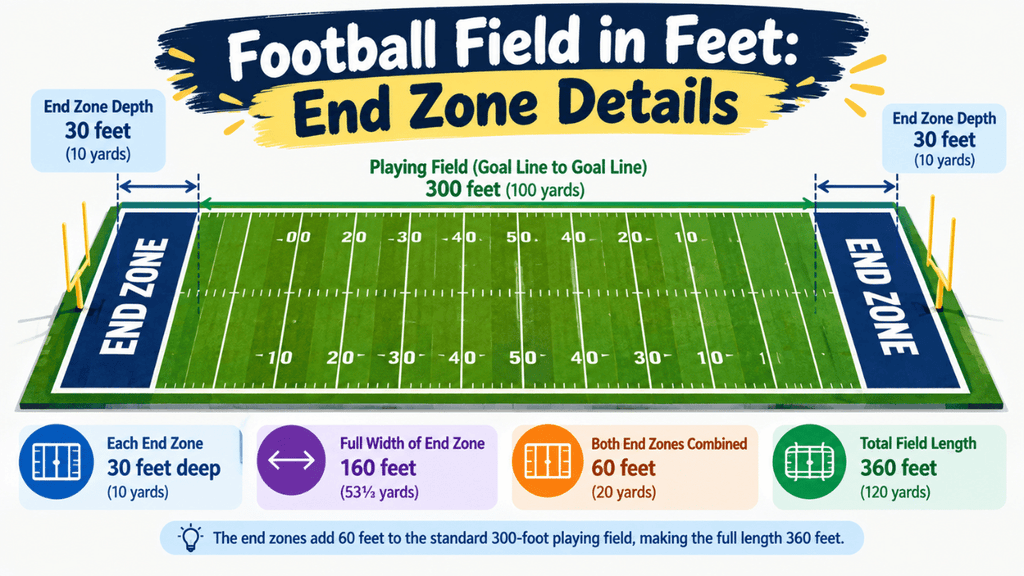
The end zones matter so much; showing them in feet breakdown is a big part of your average football field because they are often the most ignored section of chatter about the total footprint of the field. They are both exactly 30 feet deep and the full 160-foot width of the field. Both end zones together take away 60 of the 360 feet that make up a football field, meaning you only need to subtract and include one-sixth of a football field in feet when counting them up (both end zones together).
Also Read: Full Bed Dimensions in Feet | Standard Magazine Size | Pringles Can Size
Hash Marks and Yard Lines
This might also mean knowing how it ends in dimensions that make clear the internal markings that guide, respectively, how the play proceeds on the football field – with yards denoting distance among player runs. Painted yard lines across the surface of the pitch in 5-yard increments, bold numbers indicating every 10 yards to enable players, officiating crews, and fans to quickly gauge field position.
These are the hash marks (the shorter lines that mimic the yard lines running parallel to them, halfway between the center of the field).
| Level of Play | Hash Mark Distance from Sideline |
| NFL | 70 feet 9 inches |
| NCAA (College) | 60 feet |
| High School | 53 feet 4 inches |
The difference in hash mark placement might seem like one of the more obscure details when breaking down a football field in feet, but this actually does influence gameplay, as narrower hash mark spacing usually leads to more equitable field position for goings on from either hash.
Goal Post Dimensions
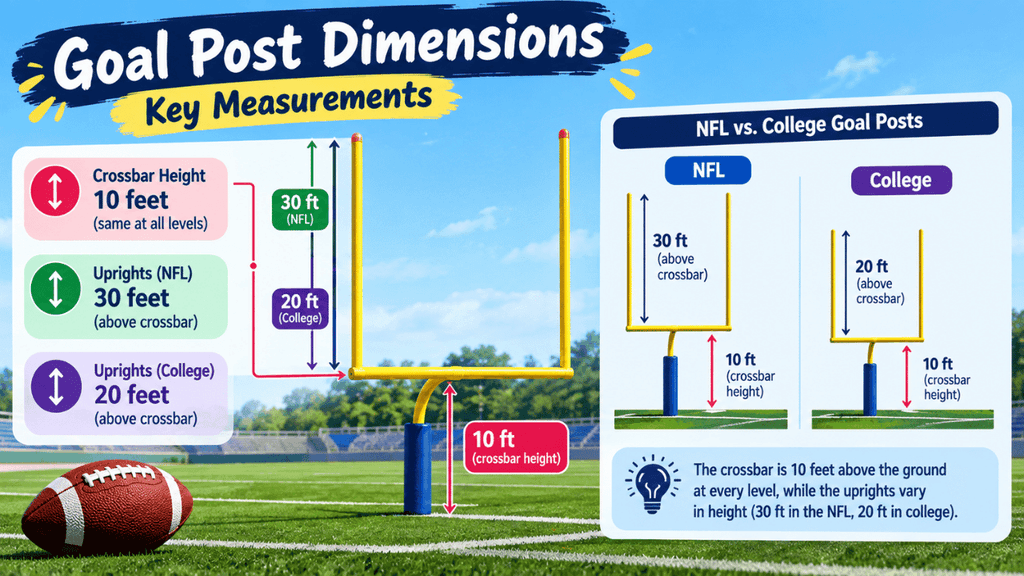
A breakdown of a football field in feet wouldn’t be complete without discussing the goal posts. Across every level of organized football, the crossbar stands precisely 10 feet above the ground. As for those uprights themselves, they vary in height depending on the level of play – NFL uprights rise 30 feet above the crossbar while college uprights usually top out at around 20 feet above it.
Unlike, say, field length and width, which varies by different governing bodies the horizontal distance between the two uprights are a constant 18 feet 6 inches between both uprights in either the NFL or NCAA and most high school fields.
| Goal Post Measurement | Figure |
| Crossbar Height | 10 feet |
| Upright Width (distance apart) | 18 feet 6 inches |
| NFL Upright Height Above Crossbar | 30 feet |
| College Upright Height Above Crossbar | ~20 feet |
Measuring a Football Field Yourself
When measuring out a football field in feet, firsthand experience – such as on a local school field or at a public park – is only useful if you have the right tools ready for the job at hand: Measuring wheels or tape measures are the most straightforward tools. Measurement: From the rear edge of 1 end zone all the way to the rear edge of its respective goal line for a full 360-foot length; measure between goal lines specifically if you only want that handy 300-foot playing field figure. For the width, measuring from sideline to sideline anywhere on the field should always be 160 feet – that is, if the field is built to specification.
Football Field in Feet vs Soccer Pitch Size
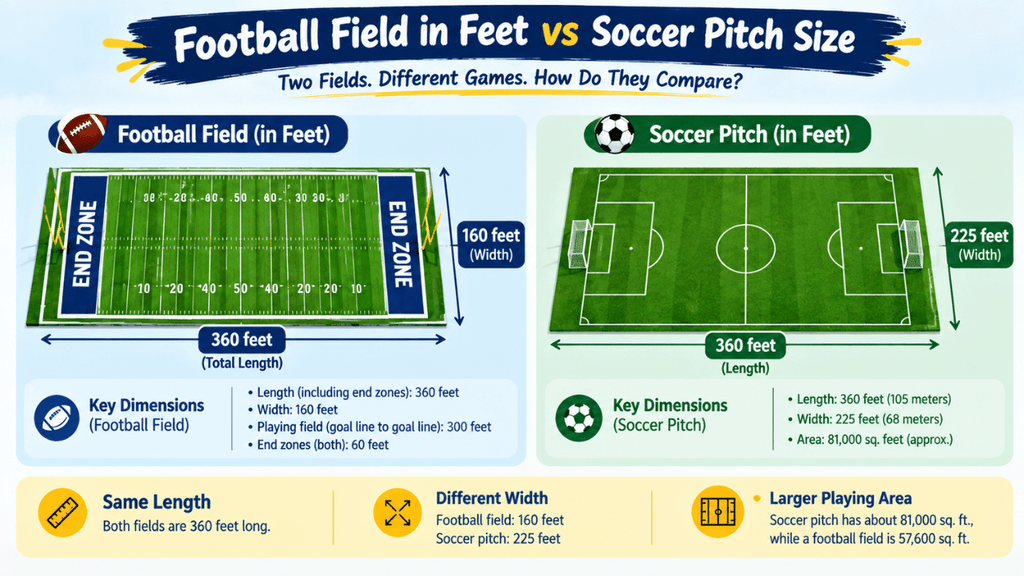
That said, the word “football” means a different thing in different places; international readers searching for a football field in feet might literally be describing a soccer pitch rather than an American gridiron. FIFA rulebook provides for more variations in dimensions of soccer pitches than American football fields, allowing them to be anywhere from 300-390 feet long and 150–300 wide, with international matches usually restricting the length to between 330 and 360. In contrast to American football, which plays on a mostly uniform gridiron (100 yards long and 53.33 yards wide), genuine soccer pitches do vary from venue to venue within those approved ranges.
Why Knowing These Measurements Matters
Knowing how many feet is a football field has more practical use cases than simply satisfying general curiosity. These are the very numbers that architects and stadium designers use to design new venues. They are used by landscapers and groundskeepers for marking or clearing fields. When teachers are teaching about measurement and conversion, the football field in feet is referenced as a concrete, real world comparison.
The lengths of football fields is an informal measuring unit not limited only to sports and education, as people often refer to the measure when describing the size of anything from a cruise ship to a natural disaster’s debris field, which makes having correct feet-based numbers really handy well outside the scope of just sport.
Common Comparisons Using a Football Field in Feet
| Aspect | Details |
| Football Field Length | 360 feet |
| Common Use | Used as an informal yardstick to explain the size of large objects and spaces. |
| News Reports | Wildfires, icebergs, shipwrecks, and other large subjects may be described as being several football fields in size. |
| Real Estate | Large commercial properties or rural land areas may be compared to the number of football fields they could cover. |
| Why It Works | Most people have a more intuitive understanding of a football field’s size than abstract measurements such as acreage. |
| Communication Benefit | Comparing something to a football field makes large-scale measurements easier to visualize and understand. |
| Common Examples | “Several football fields” can quickly communicate the approximate scale of a large area or object. |
Also Read: Toyota SUV Models by Size | Monster Can Dimensions | Celsius Can Dimensions
Conclusion
Using traditional units, a football field is 360 feet long (including both end zones) and 160 feet wide, totaling a playing surface of some 57,600 square feet. Whether its comparing it to a soccer pitch, getting an idea of how big a stadium actually is when laid out this way, or just debating over what 100 yards actually looks like without measuring tape, a reference number gets us there more accurately than the rough and widely quoted notion that it’s “just” 100 yards without end zone consideration.
Frequently Asked Questions
1. How many feet long is a football field, including the end zones?
A traditional American football field measures 360 feet long with two 30-foot-long end zones. The area between the goal lines is 300 feet.
2. How wide is a football field in feet?
The width of an average football field is 160 feet (53⅓ yards).
3. Which is why one end zone is how many feet?
The end zones are 30 feet deep each (60 feet combined).
4. How many feet are in a Football field surface area?
One football field is 57,600 sq ft, aka 1.32 acres.
5. How do hash marks change the configuration of a football field?
Yes. This means that at the NFL level, college and high school football hash-mark positions are all different.