
Pick a magazine off the newsagent, a fashion title maybe, or a weekly with current affairs stories; an issue about home decor, and one about travel, then you are holding an object composed of dozens of publishing decisions made before a sentence was typed or snapped captured. Size is probably one of the most fundamental feats of those decisions. Standard magazine size isn’t a technical specification. It is a single measure of content, audience, distribution, cost, and brand.
But it is something mostly never thought of by most readers. They grab Time and Vogue and National Geographic without realizing that results in a mix of magazines with different formats or that the differences among them are purposeful, strategic, distinct. This guide takes it all apart: The most current magazine dimensions both in the United States and abroad, how each format works best for varying types of content, what does letter mean (or digest or tabloid or A4 or A5), plus everything any publisher or designer needs to know to choose a print-formatted window for an upcoming print magazine.
Standard Magazine Size: What is it?
There are two defensible answers to this question, hence all the confusion around it.
The Phrasing: “Standard magazine size” means the usual trim size of a printed magazine. Dimensions are 8.375 x 10.875 inches (212 x 276mm). That is the same as 21.3 by 27.6 centimetres, which is the size used at most newsstands.
But in day-to-day practice and publishing, especially in the U.S.A., letter size is the true standard reference when people say “standard.”
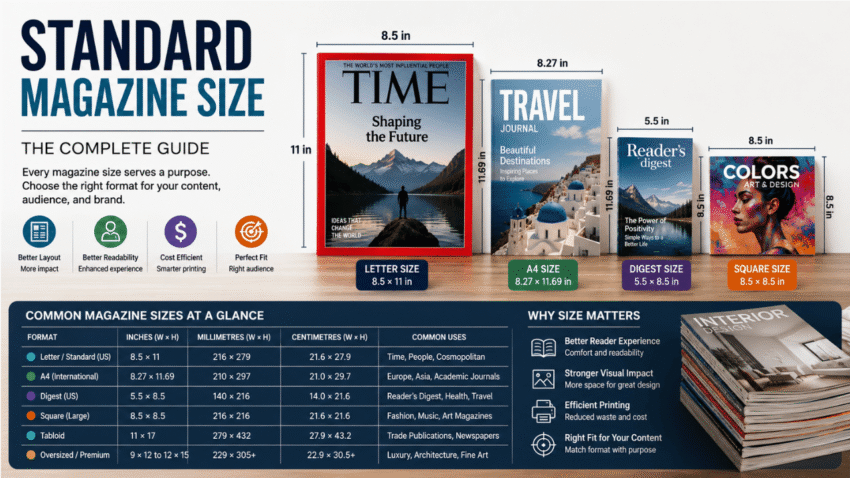
The common magazine size in the USA is 8.5 × 11 inches (216 × 279 mm), the same as letter paper (for printing). This is the format used by 60–70% of American consumer magazines, as it uses no waste and matches perfectly with standard printing presses.
This is the common magazine size of 8.5 × 11 inches (letter size) used by such magazines as Time and People.
For our practical purposes: the standard magazine size is portrait 8.5 × 11 inches (21.6 × 27.9 cm) in North America. Any other shape digest, tabloid, square, oversized, A4 is either a variation on this baseline or deliberate for publishing reasons.
Full Magazine Size Reference Table
The magazine size is 8-3/8 × 10-7/8 inches (21 × 30 cm). Below is a detailed reference chart on almost all the important formats in use worldwide:
| Format | Inches (W × H) | Millimetres (W × H) | Centimetres (W × H) | Common Uses |
| Letter / Standard (US) | 8.5 × 11 | 216 × 279 | 21.6 × 27.9 | Time, People, Cosmopolitan, National Geographic |
| Standard (Trim Size) | 8.375 × 10.875 | 212 × 276 | 21.3 × 27.6 | Newsstand publications |
| A4 (International) | 8.27 × 11.69 | 210 × 297 | 21.0 × 29.7 | Europe, Asia, academic journals |
| Digest (US) | 5.5 × 8.5 | 140 × 216 | 14.0 × 21.6 | Reader’s Digest, health, travel |
| Digest (Trim) | 5.375 × 8.375 | 137 × 213 | 13.7 × 21.3 | Compact periodicals |
| A5 | 5.83 × 8.27 | 148 × 210 | 14.8 × 21.0 | European compact publications |
| Half Letter | 5.5 × 8.5 | 140 × 216 | 14.0 × 21.6 | Newsletters, compact titles |
| Square (Small) | 5.5 × 5.5 | 140 × 140 | 14.0 × 14.0 | Lifestyle, branded mini-publications |
| Square (Large) | 8.5 × 8.5 | 216 × 216 | 21.6 × 21.6 | Fashion, music, art magazines |
| Square (Premium) | 9 × 9 to 10 × 10 | 229 × 229+ | 22.9 × 22.9+ | High-end coffee table titles |
| Tabloid | 11 × 17 | 279 × 432 | 27.9 × 43.2 | Trade publications, newspapers |
| Oversized / Premium | 9 × 12 to 12 × 15 | 229 × 305+ | 22.9 × 30.5+ | Luxury fashion, architecture, fine art |
Letter size ( 8.5 × 11 Inches): The American standard
Magazines in letter size, which is one of the most common formats used for American publishing. This is standard magazine size: 8.5 inches wide by 11 inches tall, which the most common paper used in offices. Publishers prefer this format because it integrates easily with standard printing machinery. The magazine format type used for Time Magazine, National Geographic and Cosmopolitan.
Letter size (8.5 by 11 inches) is the most common magazine printing size that is used in US and preferred by the majority of publishers to accommodate plenty of content and visuals. This size gives spacious dimensions but comes at an increased cost due to more material and postage costs!
Experiments show (editorially verified) how reader experience is at this size, too. The 8.5 × 11 inches magazine size, is what we call the standard letter-size, ideal for reading and can carry in your hands without an issue. You will have some more space to design the pages of your image publication as a larger magazine has more graphics to offer. It also allows for more text, which can result in lengthier posts and long-form articles.
A4 Size (8.27 × 11.69 Inches): Worldwide Standard
The common size used in magazines is 8.5 × 11 inches, all over the USA, this is also commonly known as letter size. Small magazines are not really A4; A4 is 21 × 29.7 cm, which is slightly taller than US standard magazines.
This means that outside of North America, basically everywhere from Europe to Asia to Australia and most the rest of the world, magazine size becomes A4. A4 is the international magazine standard for Europe and Asia.A North American magazine will typically be letter size (8.5 × 11 inches).
A4 (standard paper size) The A4 format is part of the ISO 216 series of standard magazine size, with each size occupying half of the area of the previous one and possessing a common aspect ratio. It also means you can scale content between sizes in A-series without about distorting proportions, which is a huge benefit for publishers running multiple editions internationally.
For international editions of Vogue, A4 (8.27×11.7 inches) is preferred. The A4 standard is also what the European and Asian editions of Vogue, not to mention magazines all over the world, use for their publication, the American edition measures only slightly differently at 8.5 × 11 inches. This is a tangible illustration of the way that one publication shifts its physical format based on geography, not editorial content, but literally what you are holding in your hands.
Also Read: How Far Is 50 Feet | How Big Is 8 Inches | 36 Inches
Digest Size (5.5 × 8.5 Inches): Small and Portable
These are small digest-size magazines, aka 5.5 × 8.5 inches, which is as compact and portable a reading experience as you can best imagine. The dimensions, 5.5 by 8.25 inches, are ideal for zines, newsletters, and short publications as a compact-size magazine.
The name references the publishing idea of condensing, or “digesting” content, i.e. not writing long-form journalism across full pages but summarising and collating in a few paragraphs instead. Reader’s Digest, the magazine that coined this format, constructed one of the largest paid circulation subscriber bases in history on the idea that people wanted good writing they could read during a commute, stow in a coat pocket and finish in one sitting.
Digest-size or smaller magazines are common in lifestyle, health, and travel genres where eye-catching photography and articles can be read on the way to work or while taking a break. In contrast, larger magazines are more difficult to transport and may prove cumbersome to read. The designs are usually simple, with quick articles.
The Tabloid Size (11 × 17 Inches): For Major Impact
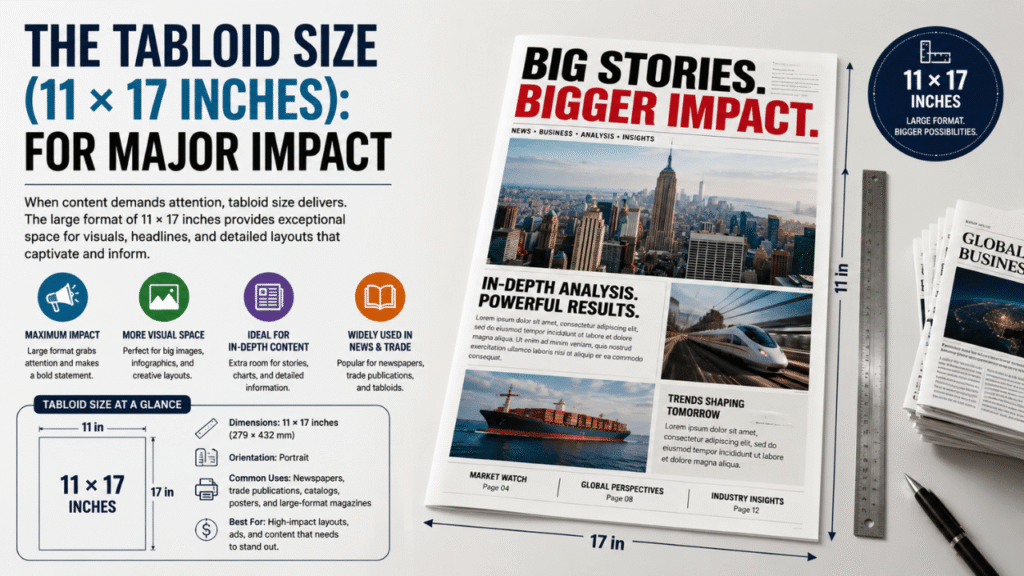
And US magazine sizes range from smaller digest sizes to large tabloids. Popular sizes are letter size (8.5 × 11 inches), digest (5.5 × 8.5 inches) and tabloid (11 × 17 inches).
The tabloid, which is 17 inches by 11 inches or broadsheet in some contexts opens up a dramatically larger canvas for content. Such format is designed for trade publications, B2B magazines AND niche industry titles that have a technical diagram or bigger data table or oversized photography that justifies the additional space. This is relatively rare in consumer publishing where this format is not as comfortable for continually extending formats of reading, less portable and more expensive to produce and deliver.
However, in design terms the tabloid creates opportunities that are not possible at letter size – double-page spreads feel perfect for drama and large infographics can breathe, while photography can be at a scale to wash over the reader.
Oversized and Premium Formats (9 × 12 and Above)
Oversized magazines are 9 by 12 inches but range up to around 12 by 15 inches or more. These are premium magazine size displays for high-end fashion, architecture and fine art content. That broader layout allows for luxe reading experiences, which in turn command premium prices.
Oversized formats are often employed to mark premium positioning within high-end fashion titles, architecture publications, fine art catalogues and museum publications. Before any page is turned, a 12 × 15 inch coffee-table magazine makes a bold statement. The heavy paper stock, the scale of the imagery and even just how big such an object is all shout luxury in a way that something made for a regular letter-size format cannot.
The trade-off is distribution. It’s no surprise that oversized publications have trouble finding retail rack space, standard mail envelopes, or even standard display systems. You will find them mainly in bookshops and museum gift shops, specialist retailers and via direct subscription, never on a mass-market newsstand.
Standard Magazine Bleed and Safe Zone Requirements
The next step is to select a size, but that is only one half of the design specification. A bleed extra content past the trim line, which is cut off during production, and a safe zone inside the trim line where all essential content should live are present in every professional print magazine design.
Magazine-style layouts are generally 0.125 inches of bleed and a safe zone, minimum space from the cut line that adds another 0.25 inch to your margins so nothing gets trimmed off. CMYK colour mode converts digital colours to their print counterparts accurately.
Basically, for an 8.5 by 11 magazine:
- Bleed: 8.75 by 11.25 inches (0.125 inch added to each edge)
- Trim safe outer edge: no critical text and logos should be located at least 0.25 inch from the edge of the trim
Print publications require consideration of print magazine size and magazine layout dimensions. 80-130 lb cover stock helps keep things sturdy, and you’ll definitely want to use text weight paper between 60-100 lb for your interiors. The standard magazine size cover will help the magazine to look attractive on shelves.
Digital Magazine Dimensions
Print specifications are fundamentally different from digital magazine formats. Publishing for screens and print uses pixel dimensions and physical specs. The content should be able to adapt properly across all the distribution channels, and understanding both formats ensures that. For professional quality, print magazines demand 300 DPI.
Pixel resolution and screen size adaptability are important for digital magazines. Mobile uses 72-150 PPI, Desktop formats are 72-150 DPI, and tablets use 150 DPI. RGB colour mode is the default, because screens are set up for accurate display in this medium. Make sure your content is responsive so that it reads well and adjusts itself to different devices, or create PDF exports.
Publishers with print and digital versions essentially every leading publication of 2026, then need to ensure the design process can work for both physical trim size (for the print version) and pixel-based properties (for screens). The common practice is to create for print resolution (300DPI) first and then export downsampled versions for digital channels, not the other way around.
Implementing Decision Framework for Selecting a Magazine Size
When planning an entirely new publication or redesigning one currently in circulation, the decision on dimensions encompasses several overlapping factors:
| Factor | Questions to Ask |
| Content type | Does your content need large images, or is it text-heavy? |
| Audience | Is portability important to your readers? |
| Distribution | Will you sell on newsstands, by subscription, or in specialist retail? |
| Budget | What printing and postage costs can your model sustain? |
| Brand positioning | Should the format signal premium, accessible, or niche? |
| Binding method | Saddle-stitch (thin) or perfect-bound (thick)? |
| International reach | US letter or international A4? |
Almost 90% of the magazines sold in the online printing business are slightly away from standard sizes but you will find some that are either small or large for any specific need. A datamodel of standard magazine size unless you have a good reason to stray is good advice, the production, distribution and cost ecosystem all benefits from it.
Also Read: What Is 4 Inches | How Big Is 10 oz | How Much Is 25kg
Conclusion
Knowing the standard magazine size is more than just cementing your dimensions to memory; it will lead you toward better publishing, printing and design decisions. Although 8.5 by 11-inch (US Letter) format enjoys the dominant share of North American designers’ usage, A4, digest, tabloid, square and oversized sizes cater to diverse audiences and content types with various branding goals in mind.
The format you choose has repercussions throughout the book production process, shaping printer relationships, costs and capabilities, portability and use (think e-reader or tablet), reader experience (font choices and ebook functionality), and more. If you are starting a new magazine, setting up for press, or just looking at printing options, choosing the right standard magazine size is essential to produce a polished and professional printed publication.
FAQs About Standard Magazine Size
Q2. What is the standard magazine size for a new magazine?
This depends on the nature of your content and audience. Letter and A4 are useful, while the digest and square formats lend themselves to specific or artistic magazine issues.
Q4. Why are there different sizes of magazines?
Manufacturers pick sizes depending on design, production price, portability, branding, and the character of your content.
Q5. What are the approximate dimensions of a digest-sized magazine?
The digest magazine is 5.5 × 8.5, which means it takes up less space but is easy to carry around.
Q7. Does your magazine size affect printing costs?
Yes. Bigger magazine sizes tend to use more paper and incur higher printing costs; smaller formats, on the other hand, are usually less expensive.
Q8. What is the standard magazine bleed?
It is usually a good idea to have at least 0.125 inch (3 mm) bleed on all sides, but specifications vary by printing company.